
How the 5 Phrygian dominant positions cover the neck
On guitar the Phrygian dominant scale fits into five neck regions of five frets each: 0 to 4, 3 to 7, 5 to 9, 7 to 11 and 9 to 13. Neighbouring regions overlap by two or three frets, so together they cover the neck from the open strings to fret 13, and from fret 12 the open position comes back one octave higher.
Each region holds every scale note between its frets in one hand position, each pitch once, from the lowest note on the 6th string to the highest on the 1st. In E every region has 17 notes, two octaves and two notes, without moving the hand.

Phrygian dominant positions in E, one by one
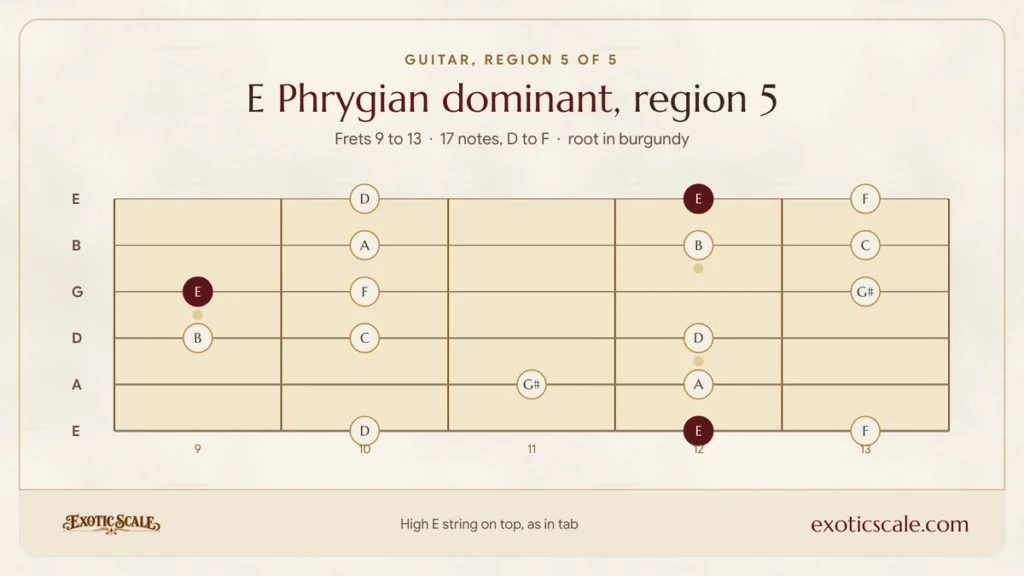
The diagrams below show the five regions in E, the main key of the scale on guitar. The roots are in burgundy: find them first, then play the region from its lowest note to its highest and back.
Position 1: Phrygian dominant in open position (frets 0 to 4)
Region 1 uses the open strings: E, A, D, B and high E are all notes of the scale, and only the G string starts on a fretted note, G# at the 1st fret. The roots are the open 6th and 1st strings and the 2nd fret of the 4th string. The note B sits both on the G string at fret 4 and on the open B string: play it open.

Position 2: Phrygian dominant at frets 3 to 7
Region 2 starts on G# at the 4th fret of the 6th string and ends on B at the 7th fret of the 1st string. Its roots fall on the 5th string at fret 7 and the 2nd string at fret 5. Keep the 1st finger around fret 3 and let the 4th finger reach fret 7 with a small stretch.

Position 3: Phrygian dominant at frets 5 to 9
Region 3 runs from A at the 5th fret of the 6th string to C at the 8th fret of the 1st string, with the roots on the 5th string at fret 7 and the 2nd string at fret 5. The E at the 9th fret of the G string is the same pitch as the E at the 5th fret of the B string; the region plays it on the B string.

Position 4: Phrygian dominant at frets 7 to 11
Region 4 starts on B at the 7th fret of the 6th string and climbs to D at the 10th fret of the 1st string. Its roots are on the 5th string at fret 7 and the 3rd string at fret 9. The B string carries only two notes here, G# and A at frets 9 and 10.

Position 5: Phrygian dominant at frets 9 to 13
Region 5 reaches the 12th fret, where the open position comes back one octave higher: the roots sit on the 6th and 1st strings at fret 12 and on the 3rd string at fret 9. On the A string it plays only G# and A, at frets 11 and 12.
How to connect the Phrygian dominant positions
Neighbouring regions share frets: regions 1 and 2 share frets 3 and 4, and each of the next pairs shares three frets. Play the top notes of one region and the bottom notes of the next on the same string, then slide the hand up a fret or two: the change never asks for a jump.
Practise in this order: one region up and down until it is even, then two neighbouring regions joined, then the whole neck with the Full neck view of the tool above, which plays the five regions one after another. Keep the roots in your ear: every region has two or three of them.
Which Phrygian dominant position to use in each key
In another key the five regions keep their frets and the notes inside them change. Start in the region that holds the root on the 6th string: region 1 for E, region 2 for G, region 3 for A, region 4 for B and region 5 for C#. The table gives the start region of every key.
| Key | Start in | Root on the 6th string | Root on the 5th string |
|---|---|---|---|
| C | Region 4 (frets 7 to 11) | fret 8 | fret 3 |
| C# | Region 5 (frets 9 to 13) | fret 9 | fret 4 |
| D | Region 5 (frets 9 to 13) | fret 10 | fret 5 |
| Eb | Region 5 (frets 9 to 13) | fret 11 | fret 6 |
| E | Region 1 (frets 0 to 4) | open | fret 7 |
| F | Region 1 (frets 0 to 4) | fret 1 | fret 8 |
| F# | Region 1 (frets 0 to 4) | fret 2 | fret 9 |
| G | Region 2 (frets 3 to 7) | fret 3 | fret 10 |
| G# | Region 2 (frets 3 to 7) | fret 4 | fret 11 |
| A | Region 3 (frets 5 to 9) | fret 5 | open |
| Bb | Region 3 (frets 5 to 9) | fret 6 | fret 1 |
| B | Region 4 (frets 7 to 11) | fret 7 | fret 2 |
For a neck map of the scale in every key, see Phrygian dominant scale on guitar. The chord player of Phrygian dominant chords on guitar uses the same five regions, so a chord and its scale sit under the same hand.
Phrygian dominant positions on guitar in all 12 keys
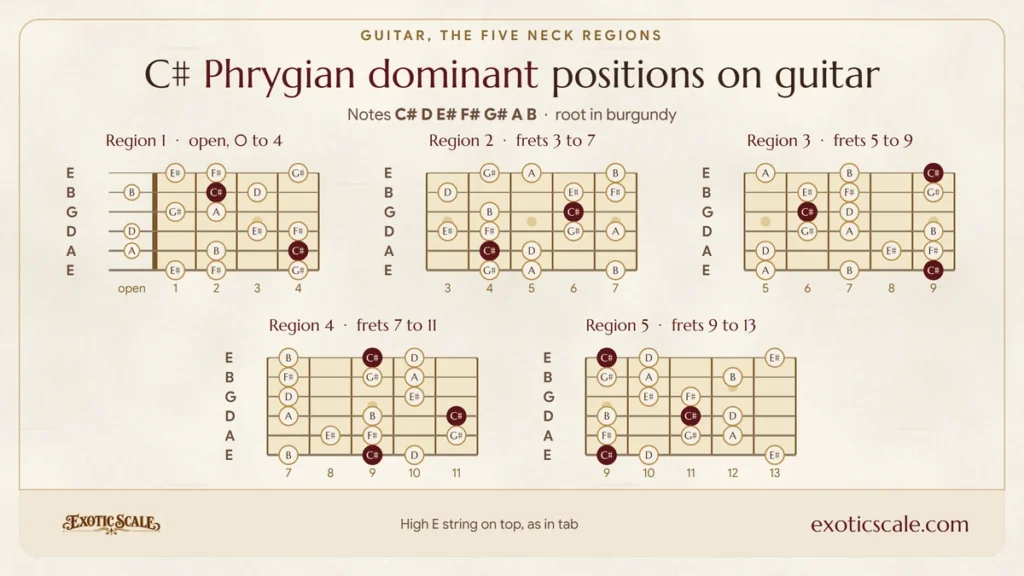
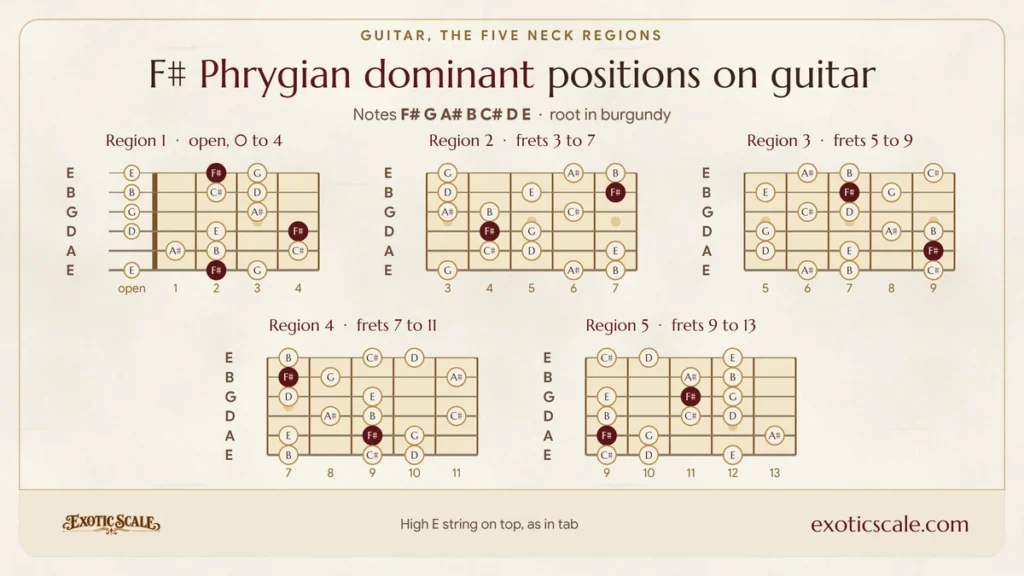
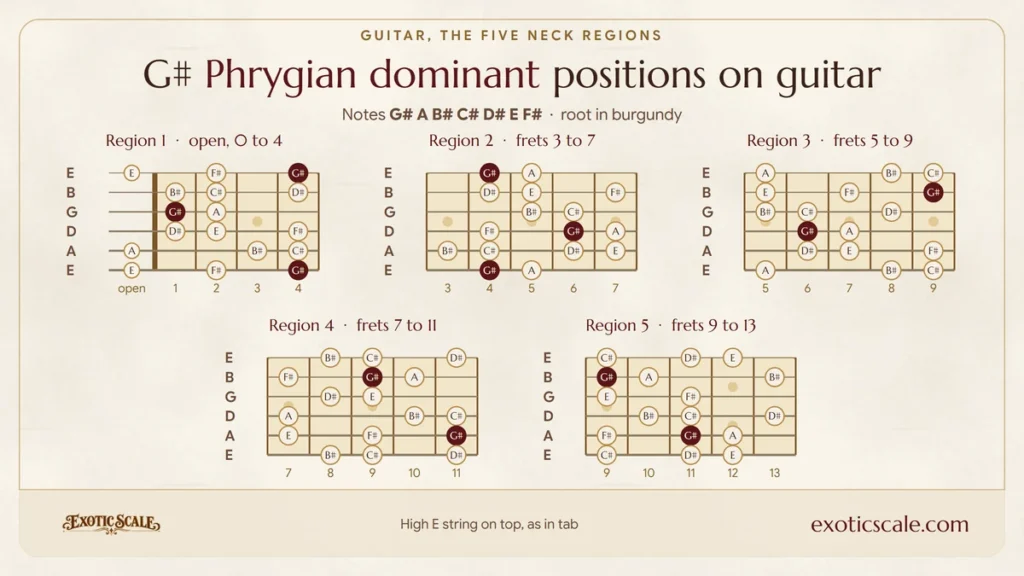
For every key: its notes, the region to start in and the five regions on the neck, each note once, the roots in burgundy.
C Phrygian dominant positions on guitar
C Phrygian dominant is C Db E F G Ab Bb. Start in region 4, where the root sits on the 6th string at fret 8; on the 5th string the root is at fret 3.
C scaleC open positionC positionsC fretboardC one stringC double stopsC chordsC inversionsC drop 2C arpeggiosC progressionsC backing track

C# Phrygian dominant positions on guitar
C# Phrygian dominant is C# D E# F# G# A B. Start in region 5, where the root sits on the 6th string at fret 9; on the 5th string the root is at fret 4.
C# scaleC# open positionC# positionsC# fretboardC# one stringC# double stopsC# chordsC# inversionsC# drop 2C# arpeggiosC# progressionsC# backing track
D Phrygian dominant positions on guitar
D Phrygian dominant is D Eb F# G A Bb C. Start in region 5, where the root sits on the 6th string at fret 10; on the 5th string the root is at fret 5.
D scaleD open positionD positionsD fretboardD one stringD double stopsD chordsD inversionsD drop 2D arpeggiosD progressionsD backing track

Eb Phrygian dominant positions on guitar
Eb Phrygian dominant is Eb Fb G Ab Bb Cb Db. Start in region 5, where the root sits on the 6th string at fret 11; on the 5th string the root is at fret 6.
Eb scaleEb open positionEb positionsEb fretboardEb one stringEb double stopsEb chordsEb inversionsEb drop 2Eb arpeggiosEb progressionsEb backing track

E Phrygian dominant positions on guitar
E Phrygian dominant is E F G# A B C D. Start in region 1, where the root sits on the 6th string open; on the 5th string the root is at fret 7.
E scaleE open positionE positionsE fretboardE one stringE double stopsE chordsE inversionsE drop 2E arpeggiosE progressionsE licksE ornamentsE flamenco techniqueE backing track

F Phrygian dominant positions on guitar
F Phrygian dominant is F Gb A Bb C Db Eb. Start in region 1, where the root sits on the 6th string at fret 1; on the 5th string the root is at fret 8.
F scaleF open positionF positionsF fretboardF one stringF double stopsF chordsF inversionsF drop 2F arpeggiosF progressionsF backing track

F# Phrygian dominant positions on guitar
F# Phrygian dominant is F# G A# B C# D E. Start in region 1, where the root sits on the 6th string at fret 2; on the 5th string the root is at fret 9.
F# scaleF# open positionF# positionsF# fretboardF# one stringF# double stopsF# chordsF# inversionsF# drop 2F# arpeggiosF# progressionsF# backing track
G Phrygian dominant positions on guitar
G Phrygian dominant is G Ab B C D Eb F. Start in region 2, where the root sits on the 6th string at fret 3; on the 5th string the root is at fret 10.
G scaleG open positionG positionsG fretboardG one stringG double stopsG chordsG inversionsG drop 2G arpeggiosG progressionsG backing track

G# Phrygian dominant positions on guitar
G# Phrygian dominant is G# A B# C# D# E F#. Start in region 2, where the root sits on the 6th string at fret 4; on the 5th string the root is at fret 11.
G# scaleG# open positionG# positionsG# fretboardG# one stringG# double stopsG# chordsG# inversionsG# drop 2G# arpeggiosG# progressionsG# backing track
A Phrygian dominant positions on guitar
A Phrygian dominant is A Bb C# D E F G. Start in region 3, where the root sits on the 6th string at fret 5; on the 5th string the root is open.
A scaleA open positionA positionsA fretboardA one stringA double stopsA chordsA inversionsA drop 2A arpeggiosA progressionsA licksA ornamentsA flamenco techniqueA backing track

Bb Phrygian dominant positions on guitar
Bb Phrygian dominant is Bb Cb D Eb F Gb Ab. Start in region 3, where the root sits on the 6th string at fret 6; on the 5th string the root is at fret 1.
Bb scaleBb open positionBb positionsBb fretboardBb one stringBb double stopsBb chordsBb inversionsBb drop 2Bb arpeggiosBb progressionsBb backing track

B Phrygian dominant positions on guitar
B Phrygian dominant is B C D# E F# G A. Start in region 4, where the root sits on the 6th string at fret 7; on the 5th string the root is at fret 2.
B scaleB open positionB positionsB fretboardB one stringB double stopsB chordsB inversionsB drop 2B arpeggiosB progressionsB backing track

Phrygian Dominant Guitar Positions: frequently asked questions
Short answers to the questions guitarists ask most about the Phrygian dominant guitar positions.
How many positions does the Phrygian dominant have on guitar?
This site uses five neck regions of five frets: 0 to 4, 3 to 7, 5 to 9, 7 to 11 and 9 to 13. Other systems count differently, and three notes per string gives seven shapes, but every system shows the same notes.
Which Phrygian dominant position should I learn first?
Region 1 in E, the open position: five of the six open strings belong to the scale, so the hand frets only a few notes. Then learn region 2, which shares two frets with it.
Do the positions change in other keys?
The frets of the five regions stay the same and the notes inside them change. In each key, start with the region that holds the root on the 6th string, as in the table above.
Why do some strings have only two notes in a region?
Each pitch is played once. When a note fits on two strings inside the same five frets, the region keeps it on one of them, so the other string shows only two notes.
How do I play the Phrygian dominant across the whole neck?
Join the regions one pair at a time, sliding on the string where two regions meet, then play them all in a row with the Full neck view of the tool.