
Flamenco technique on the Phrygian dominant scale
The right hand makes the flamenco sound:
picado, tremolo, thumb and arpeggio, all on one scale.
Flamenco guitarists play their scale runs, melodies and arpeggios mostly in E and A, over the harmony of the flamenco mode. The exercises on this page use E Phrygian dominant, the scale behind that sound, so the left hand stays in familiar shapes while the right hand learns the technique.
Under every tab the letters give the right-hand fingers: p thumb, i index, m middle, a ring. Every exercise is original and has its own player with Loop and Tempo; the Key menu moves it to any key, and the player on top holds all twelve.
Picado exercises: index and middle alternating
Single notes, i m i m, never two strokes in a row with the same finger:
first on one string, then across two.
Picado is the flamenco scale run, played by alternating the index and middle fingers, usually with rest strokes for a full, clear tone. Keep the alternation going even when you cross strings: that is where most players repeat a finger without noticing.
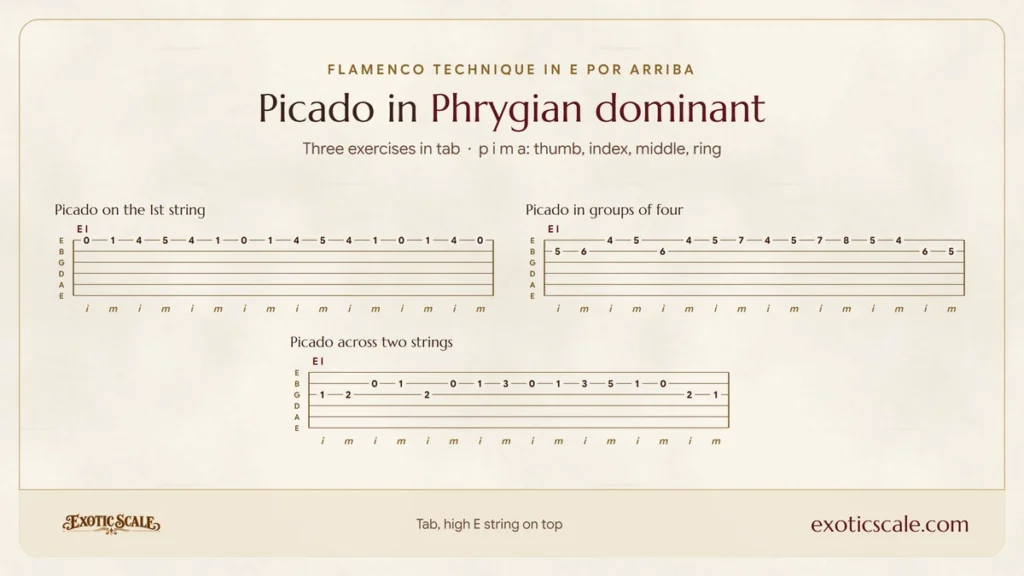
Picado on the 1st string
E F G# A and back on the high E string: the right hand only alternates.
E|0-1-4-5-4-1-0-1-4-5-4-1-0-1-4-0-|
B|--------------------------------|
G|--------------------------------|
D|--------------------------------|
A|--------------------------------|
E|--------------------------------|
Picado in groups of four
Four-note groups that climb one step at a time on the 2nd and 1st strings.
E|----4-5---4-5-7-4-5-7-8-5-4-----|
B|5-6-----6-------------------6-5-|
G|--------------------------------|
D|--------------------------------|
A|--------------------------------|
E|--------------------------------|
Picado across two strings
Three-note groups on the G and B strings, crossing on a different finger each time.
E|--------------------------------|
B|----0-1---0-1-3-0-1-3-5-1-0-----|
G|1-2-----2-------------------2-1-|
D|--------------------------------|
A|--------------------------------|
E|--------------------------------|
Flamenco tremolo, p i a m i
A bass note with the thumb, then one treble note four times:
the melody seems to ring without stopping.
Flamenco tremolo plays five strokes per group, p i a m i, where classical tremolo usually plays four, p a m i. Keep the four treble notes even in volume and time; the melody lives in them, the bass only marks the beat.
Tremolo melody on the 1st string
G# A G# F E over a moving bass.
E|--4-4-4-4---5-5-5-5---4-4-4-4---1-1-1-1---0-0-0-0---0-0-0-0---|
B|--------------------------------------------------------------|
G|--------------------------------------------------------------|
D|--------------------0-----------------------------------------|
A|----------0-------------------0-------------------------------|
E|0---------------------------------------0---------0---------0-|
Tremolo melody on the 2nd string
F E D C on the B string, F in the bass under C, home on the open B.
E|--------------------------------------------------------------|
B|--6-6-6-6---5-5-5-5---3-3-3-3---1-1-1-1---1-1-1-1---0-0-0-0---|
G|--------------------------------------------------------------|
D|--------------------------------------------------------------|
A|--------------------0---------0-------------------------------|
E|0---------0-----------------------------1---------0---------0-|
Tremolo with a falling bass
Melody and bass falling together through A, G#, F and E.
E|--5-5-5-5---4-4-4-4---1-1-1-1---0-0-0-0---1-1-1-1---0-0-0-0---|
B|--------------------------------------------------------------|
G|--------------------------------------------------------------|
D|--------------------3-----------------------------------------|
A|0---------------------------------------3---------------------|
E|----------4-------------------0-------------------0---------0-|
Thumb melodies and the road to alzapua
The thumb alone on the bass strings, with rest strokes:
the strong, round sound under every flamenco melody.
Alzapua uses the thumb in both directions, down and up, mixing melody notes and chord strokes in a pattern of three. Before that pattern, the thumb needs to play clean melodies on its own. These three exercises use only downstrokes, resting on the next string after each note.
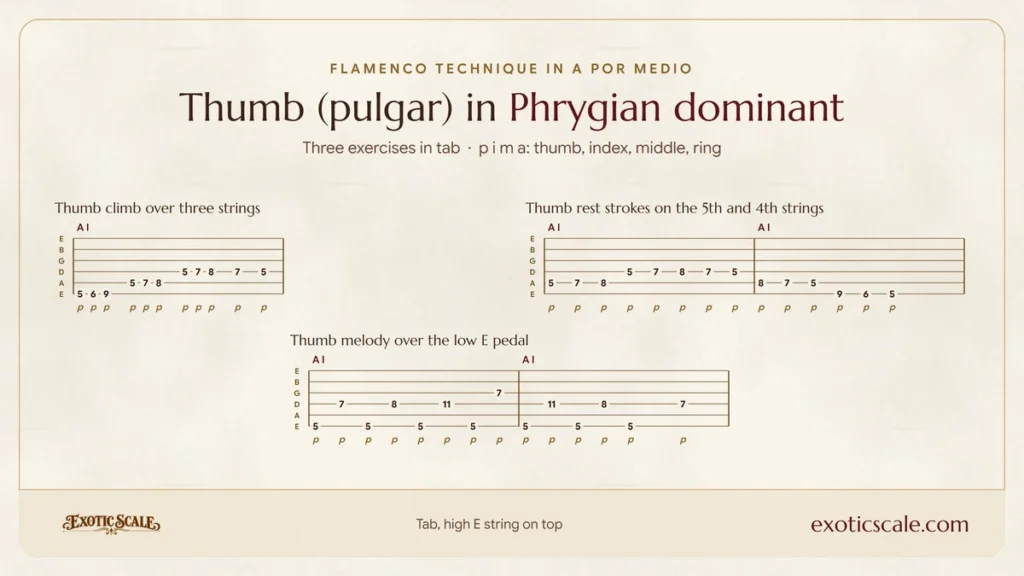
Thumb climb over three strings
From the open low E up to F on the 4th string and back to D.
E|----------------------|
B|----------------------|
G|----------------------|
D|------------0-2-3-2-0-|
A|------0-2-3-----------|
E|0-1-4-----------------|
Thumb rest strokes on the 5th and 4th strings
Eighth notes, each stroke landing on the next string.
E|----------------------------|
B|----------------------------|
G|----------------------------|
D|------0-2-3-2-0-------------|
A|0-2-3-----------3-2-0-------|
E|----------------------4-1-0-|
Thumb melody over the low E pedal
The open low E between every melody note: the thumb jumps over and back.
E|----------------------------|
B|----------------------------|
G|--------------2-------------|
D|--2---3---6-------6---3---2-|
A|----------------------------|
E|0---0---0---0---0---0---0---|
Arpeggio patterns on the E and F chords
Thumb on the bass, fingers on the treble strings:
the bII to I move of the scale in every group.
These arpeggios use the E and F shapes of open position, the half step that closes every flamenco cadence. p i m a goes up, a m i p comes down, and p a m i prepares the hand for tremolo.
Arpeggio p i m a on E and F
Thumb, index, middle, ring up the E and F shapes.
E|------0-------0-------1-------1-------1-------0---|
B|----0-------0-------1-------1-------1-------0-----|
G|--1-------1-------2-------2-------2-------1-------|
D|--------------------------------------------------|
A|--------------------------------------------------|
E|0-------0-------1-------1-------1-------0-------0-|
Reverse arpeggio a m i p
The same shapes from the top string down to the bass.
E|0-------0-------1-------1-------1-------0-------|
B|--0-------0-------1-------1-------1-------0-----|
G|----1-------1-------2-------2-------2-------1---|
D|------------------------------------------------|
A|------------------------------------------------|
E|------0-------0-------1-------1-------1-------0-|
Arpeggio p a m i
The bass, then ring, middle and index down the treble strings.
E|--0-------0-------1-------0-------4-------0-------|
B|----0-------0-------1-------0-------5-------0-----|
G|------1-------2-------2-------1-------4-------1---|
D|----------------0---------------------------------|
A|--------0-----------------------------------------|
E|0-----------------------0-------0-------0-------0-|
Rasgueado over the Phrygian dominant chords
Strumming with the fingers flicking out one after another:
practise it on the chords of the scale, not on single notes.
In rasgueado the fingers of the right hand flick out from a closed fist, little finger, ring, middle and index in turn, so one strum becomes a roll. Practise it on the E and F chords of the scale, then on the I bII I vamp: the chord progressions page has a player for every progression in this scale.
A daily flamenco technique plan
Fifteen minutes, one exercise of each kind,
slow first, then five BPM faster every few days.
Play one picado, one tremolo, one thumb and one arpeggio exercise each day, three minutes each, at a tempo where every note is even. Loop them in the players. Spend the last three minutes on rasgueado over the E and F chords. Change the exercises every week.
Flamenco technique exercises in E and A, tab sheets
Every exercise in E por arriba and A por medio, with its chords and frets,
then one tab sheet per technique. The players above move them to any key.
E Phrygian dominant flamenco exercises
In E (por arriba, the root on the open 6th string) the exercises use the notes E F G# A B C D; the half step F to E closes most phrases.
E scaleE open positionE positionsE fretboardE one stringE double stopsE chordsE inversionsE drop 2E arpeggiosE progressionsE licksE ornamentsE flamenco techniqueE backing track
| Name | Technique | Over | Frets |
|---|---|---|---|
| Picado on the 1st string | Picado | E | 0 to 5 |
| Picado in groups of four | Picado | E | 4 to 8 |
| Picado across two strings | Picado | E | 0 to 5 |
| Tremolo melody on the 1st string | Tremolo | E | E | 0 to 5 |
| Tremolo melody on the 2nd string | Tremolo | E | E | 0 to 6 |
| Tremolo with a falling bass | Tremolo | E | E | 0 to 5 |
| Thumb climb over three strings | Thumb (pulgar) | E | 0 to 4 |
| Thumb rest strokes on the 5th and 4th strings | Thumb (pulgar) | E | E | 0 to 4 |
| Thumb melody over the low E pedal | Thumb (pulgar) | E | E | 0 to 6 |
| Arpeggio p i m a on E and F | Arpeggio | E | E | 0 to 2 |
| Reverse arpeggio a m i p | Arpeggio | E | E | 0 to 2 |
| Arpeggio p a m i | Arpeggio | E | E | 0 to 5 |


A Phrygian dominant flamenco exercises
In A (por medio, the root on the open 5th string) the exercises use the notes A Bb C# D E F G; the half step Bb to A closes most phrases.
A scaleA open positionA positionsA fretboardA one stringA double stopsA chordsA inversionsA drop 2A arpeggiosA progressionsA licksA ornamentsA flamenco techniqueA backing track
| Name | Technique | Over | Frets |
|---|---|---|---|
| Picado on the 1st string | Picado | A | 5 to 10 |
| Picado in groups of four | Picado | A | 9 to 13 |
| Picado across two strings | Picado | A | 5 to 10 |
| Tremolo melody on the 1st string | Tremolo | A | A | 5 to 10 |
| Tremolo melody on the 2nd string | Tremolo | A | A | 5 to 11 |
| Tremolo with a falling bass | Tremolo | A | A | 5 to 10 |
| Thumb climb over three strings | Thumb (pulgar) | A | 5 to 9 |
| Thumb rest strokes on the 5th and 4th strings | Thumb (pulgar) | A | A | 5 to 9 |
| Thumb melody over the low E pedal | Thumb (pulgar) | A | A | 5 to 11 |
| Arpeggio p i m a on E and F | Arpeggio | A | A | 5 to 7 |
| Reverse arpeggio a m i p | Arpeggio | A | A | 5 to 7 |
| Arpeggio p a m i | Arpeggio | A | A | 5 to 10 |



Flamenco Scale Picado Exercises in Phrygian Dominant: frequently asked questions
Short answers to the questions guitarists ask most about the Flamenco scale picado exercises in phrygian dominant.
What is picado in flamenco guitar?
Single-note scale runs played by alternating the index and middle fingers, usually with rest strokes. It is the flamenco way of playing fast melodies.
How do I practise picado?
Start on one string so the right hand only alternates, then add string crossings. Use a slow tempo, even notes, and raise the tempo a little every day.
What is the flamenco tremolo pattern?
p i a m i: the thumb plays a bass note, then the ring, middle and index fingers and the index again repeat one treble note. Classical tremolo usually plays three repeats, p a m i.
What is alzapua?
A thumb technique with strokes down and up, often in a repeating three-stroke pattern of melody and chord. It is said to have roots in the plectrum technique of the oud.
What is rasgueado?
Flamenco strumming: the fingers flick out one after another across the strings, little finger, ring, middle and index, to make a roll.