Home / Scales / Phrygian Dominant Scale / Phrygian Dominant Scale on Guitar / Phrygian Dominant Arpeggios on Guitar

Phrygian Dominant · Guitar

Phrygian Dominant Arpeggios on Guitar

Phrygian dominant arpeggios are the seven chords of the scale played one note at a time. In E they are E, F, G#dim, Am, Bdim, C+ and Dm, or E7, Fmaj7, G#dim7, Am(maj7), Bm7b5, Cmaj7#5 and Dm7 with the 7th. The E7 arpeggio, E G# B D, carries the sound of the scale.

E Phrygian dominant
  1. E1
  2. Fb2
  3. G#3
  4. A4
  5. B5
  6. Cb6
  7. Db7

What are Phrygian dominant arpeggios?

An arpeggio is a chord played one note at a time, from the root up and back down. The Phrygian dominant scale has seven chords, one on each degree, so it has seven arpeggios. In E, E F G# A B C D, the home arpeggio is E G# B: the root, the major 3rd and the 5th.

Every arpeggio uses only notes of the scale, so it fits wherever the scale fits. The difference is in the sound: an arpeggio outlines the harmony, while the scale fills the space between the chord notes. The player above shows each one on the neck in any key, and the notes of all seven in all 12 keys are at the end of this page.

Phrygian dominant triad arpeggios on guitar

Three notes each: root, 3rd and 5th. Two arpeggios are major, two minor, two diminished and one augmented.

I, E: E G# B, major, the home arpeggio.
bII, F: F A C, major, a half step above the root.
iii°, G#dim: G# B D, diminished.
iv, Am: A C E, minor.
v°, Bdim: B D F, diminished.
bVI+, C+: C E G#, augmented.
bvii, Dm: D F A, minor.

Phrygian dominant seventh arpeggios on guitar

Add the 7th and every arpeggio gets four notes. The home arpeggio becomes E7, the V7 chord of A minor, because the Phrygian dominant is the 5th mode of A harmonic minor.

I7, E7: E G# B D (R 3 5 b7).
bIImaj7, Fmaj7: F A C E (R 3 5 7).
iii°7, G#dim7: G# B D F (R b3 b5 bb7).
iv(maj7), Am(maj7): A C E G# (R b3 5 7).
vø7, Bm7b5: B D F A (R b3 b5 b7).
bVI+maj7, Cmaj7#5: C E G# B (R 3 #5 7).
bvii7, Dm7: D F A C (R b3 5 b7).

Vertical Phrygian dominant arpeggios in the five neck regions

In Region view the hand stays in one place, frets 0 to 4, 3 to 7, 5 to 9, 7 to 11 or 9 to 13, and the arpeggio crosses the strings. Each one is the scale shape of that region with only the chord notes kept, so the arpeggios and the scale share one fingering.

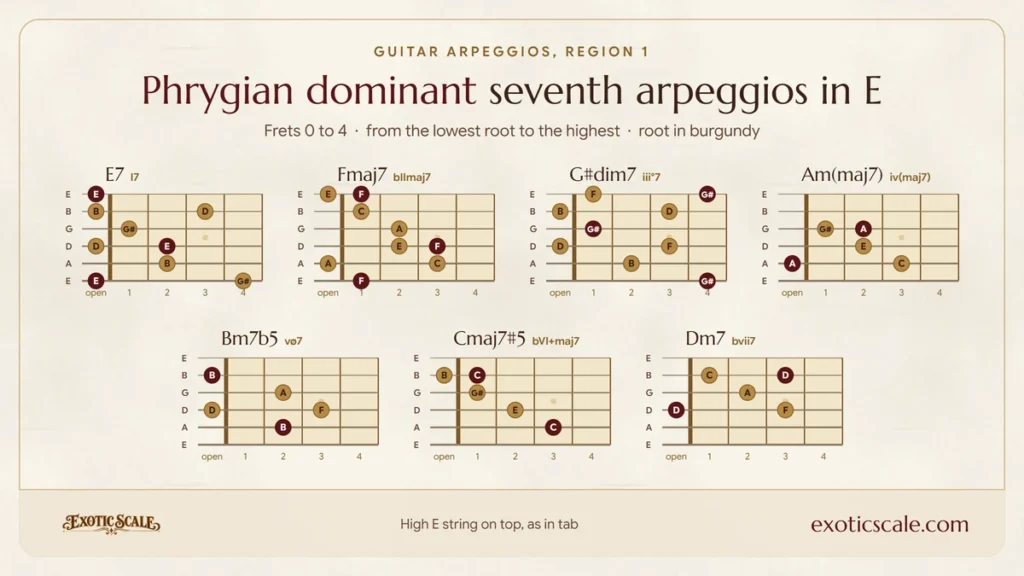
Every arpeggio starts on its lowest root inside the region and ends on its highest, on whatever string the root falls: the 6th, the 5th or the 4th. In E, region 1, the E arpeggio runs from the open low E to the open high E: E and G# on the 6th string, B on the 5th, E on the 4th, G# on the 3rd, then the open B and E strings.

Horizontal Phrygian dominant arpeggios along the neck

In Full neck view the arpeggio starts on the root of the 6th, 5th or 4th string and travels up the neck, two notes per string, a third only when the next string would send the hand back down. It always ends on a root, two octaves above the start or as high as fret 15 allows.

The E arpeggio from the 6th string: open E and G# at fret 4, then B at fret 2 and E at fret 7 on the 5th string, G# at fret 6 and B at fret 9 on the 4th, and E at fret 9 on the 3rd string. Two octaves, from the nut to the 9th fret.

How to improvise with Phrygian dominant arpeggios

Play the arpeggio of the chord you are on. Over E7 the E7 arpeggio lands on the chord notes; over F it is Fmaj7. Use the rest of the scale to move between them.

Over E7, the G#dim7 arpeggio, G# B D F, is the E7 chord without its root plus the b9, F. That is why it sounds like E7b9, the colour of the Phrygian dominant. A diminished seventh repeats every minor 3rd, so the same shape works three frets higher or lower.

How to practise Phrygian dominant arpeggios on guitar

Start slowly in one region: click E and F in the player and let each arpeggio play from root to root. Then press Play to hear the seven in order with the tempo low, and play along.

When the region feels easy, switch to Full neck and choose the 6th, 5th or 4th string for the root. Turn on Intervals to see the root, 3rd, 5th and 7th of every arpeggio.

Phrygian dominant arpeggios on guitar in all 12 keys

For every key: the seven arpeggios of the scale, triads and seventh chords, with their notes and intervals, then the arpeggios on the neck in the region where the root sits on the 6th string, from root to root.

C Phrygian dominant arpeggios on guitar

The seven arpeggios of C Phrygian dominant start on C, Db, E, F, G, Ab, Bb. Each one is a chord of the scale played note by note: C, Db, Edim, Fm, Gdim, Ab+, Bbm as triads, C7, Dbmaj7, Edim7, Fm(maj7), Gm7b5, Abmaj7#5, Bbm7 with the 7th.

Triad and seventh arpeggios on each degree of C phrygian dominant, with their intervals
DegreeTriadNotesSeventhNotes (intervals)
ICC E GC7C E G Bb (R 3 5 b7)
bIIDbDb F AbDbmaj7Db F Ab C (R 3 5 7)
iii°EdimE G BbEdim7E G Bb Db (R b3 b5 bb7)
ivFmF Ab CFm(maj7)F Ab C E (R b3 5 7)
v°GdimG Bb DbGm7b5G Bb Db F (R b3 b5 b7)
bVI+Ab+Ab C EAbmaj7#5Ab C E G (R 3 #5 7)
bviiBbmBb Db FBbm7Bb Db F Ab (R b3 5 b7)
The seven Phrygian dominant triad arpeggios in C on guitar, region 4, frets 7 to 11, each from root to root. C: C 6th string fret 8, E 5th string fret 7, G 5th string fret 10, C 4th string fret 10, E 3rd string fret 9, G 2nd string fret 8, C 1st string fret 8; Db: Db 6th string fret 9, F 5th string fret 8, Ab 5th string fret 11, Db 4th string fret 11, F 3rd string fret 10, Ab 2nd string fret 9, Db 1st string fret 9; Edim: E 5th string fret 7, G 5th string fret 10, Bb 4th string fret 8, E 3rd string fret 9; Fm: F 5th string fret 8, Ab 5th string fret 11, C 4th string fret 10, F 3rd string fret 10; Gdim: G 5th string fret 10, Bb 4th string fret 8, Db 4th string fret 11, G 2nd string fret 8; Ab+: Ab 5th string fret 11, C 4th string fret 10, E 3rd string fret 9, Ab 2nd string fret 9; Bbm: Bb 4th string fret 8, Db 4th string fret 11, F 3rd string fret 10, Bb 2nd string fret 11.
Phrygian dominant triad arpeggios in C, region 4, frets 7 to 11: C, Db, Edim, Fm, Gdim, Ab+, Bbm.
The seven Phrygian dominant seventh arpeggios in C on guitar, region 4, frets 7 to 11, each from root to root. C7: C 6th string fret 8, E 5th string fret 7, G 5th string fret 10, Bb 4th string fret 8, C 4th string fret 10, E 3rd string fret 9, G 2nd string fret 8, Bb 2nd string fret 11, C 1st string fret 8; Dbmaj7: Db 6th string fret 9, F 5th string fret 8, Ab 5th string fret 11, C 4th string fret 10, Db 4th string fret 11, F 3rd string fret 10, Ab 2nd string fret 9, C 1st string fret 8, Db 1st string fret 9; Edim7: E 5th string fret 7, G 5th string fret 10, Bb 4th string fret 8, Db 4th string fret 11, E 3rd string fret 9; Fm(maj7): F 5th string fret 8, Ab 5th string fret 11, C 4th string fret 10, E 3rd string fret 9, F 3rd string fret 10; Gm7b5: G 5th string fret 10, Bb 4th string fret 8, Db 4th string fret 11, F 3rd string fret 10, G 2nd string fret 8; Abmaj7#5: Ab 5th string fret 11, C 4th string fret 10, E 3rd string fret 9, G 2nd string fret 8, Ab 2nd string fret 9; Bbm7: Bb 4th string fret 8, Db 4th string fret 11, F 3rd string fret 10, Ab 2nd string fret 9, Bb 2nd string fret 11.
Phrygian dominant seventh arpeggios in C, region 4, frets 7 to 11: C7, Dbmaj7, Edim7, Fm(maj7), Gm7b5, Abmaj7#5, Bbm7.

C# Phrygian dominant arpeggios on guitar

The seven arpeggios of C# Phrygian dominant start on C#, D, E#, F#, G#, A, B. Each one is a chord of the scale played note by note: C#, D, E#dim, F#m, G#dim, A+, Bm as triads, C#7, Dmaj7, E#dim7, F#m(maj7), G#m7b5, Amaj7#5, Bm7 with the 7th.

Triad and seventh arpeggios on each degree of C# phrygian dominant, with their intervals
DegreeTriadNotesSeventhNotes (intervals)
IC#C# E# G#C#7C# E# G# B (R 3 5 b7)
bIIDD F# ADmaj7D F# A C# (R 3 5 7)
iii°E#dimE# G# BE#dim7E# G# B D (R b3 b5 bb7)
ivF#mF# A C#F#m(maj7)F# A C# E# (R b3 5 7)
v°G#dimG# B DG#m7b5G# B D F# (R b3 b5 b7)
bVI+A+A C# E#Amaj7#5A C# E# G# (R 3 #5 7)
bviiBmB D F#Bm7B D F# A (R b3 5 b7)
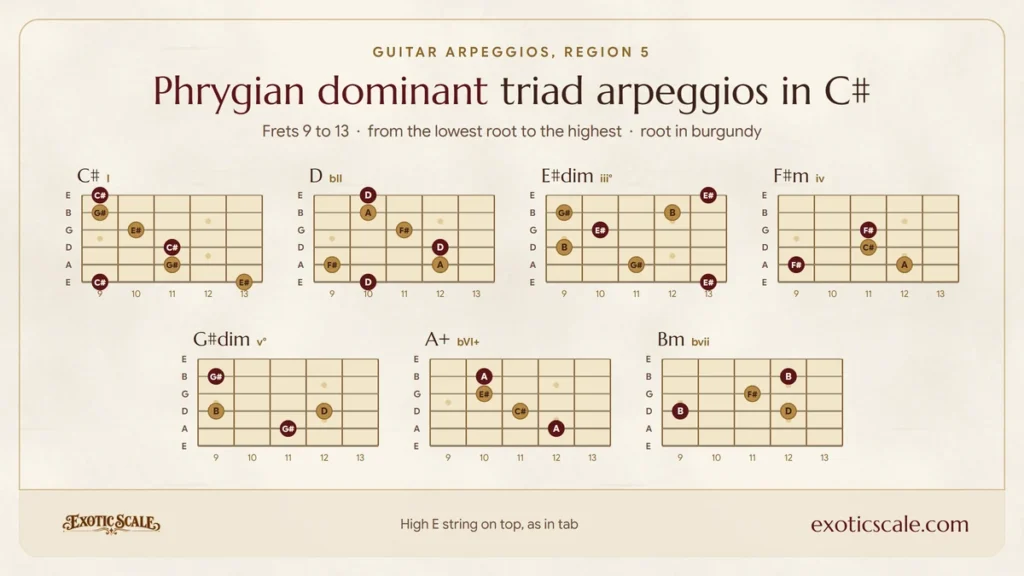
The seven Phrygian dominant triad arpeggios in C# on guitar, region 5, frets 9 to 13, each from root to root. C#: C# 6th string fret 9, E# 6th string fret 13, G# 5th string fret 11, C# 4th string fret 11, E# 3rd string fret 10, G# 2nd string fret 9, C# 1st string fret 9; D: D 6th string fret 10, F# 5th string fret 9, A 5th string fret 12, D 4th string fret 12, F# 3rd string fret 11, A 2nd string fret 10, D 1st string fret 10; E#dim: E# 6th string fret 13, G# 5th string fret 11, B 4th string fret 9, E# 3rd string fret 10, G# 2nd string fret 9, B 2nd string fret 12, E# 1st string fret 13; F#m: F# 5th string fret 9, A 5th string fret 12, C# 4th string fret 11, F# 3rd string fret 11; G#dim: G# 5th string fret 11, B 4th string fret 9, D 4th string fret 12, G# 2nd string fret 9; A+: A 5th string fret 12, C# 4th string fret 11, E# 3rd string fret 10, A 2nd string fret 10; Bm: B 4th string fret 9, D 4th string fret 12, F# 3rd string fret 11, B 2nd string fret 12.
Phrygian dominant triad arpeggios in C#, region 5, frets 9 to 13: C#, D, E#dim, F#m, G#dim, A+, Bm.
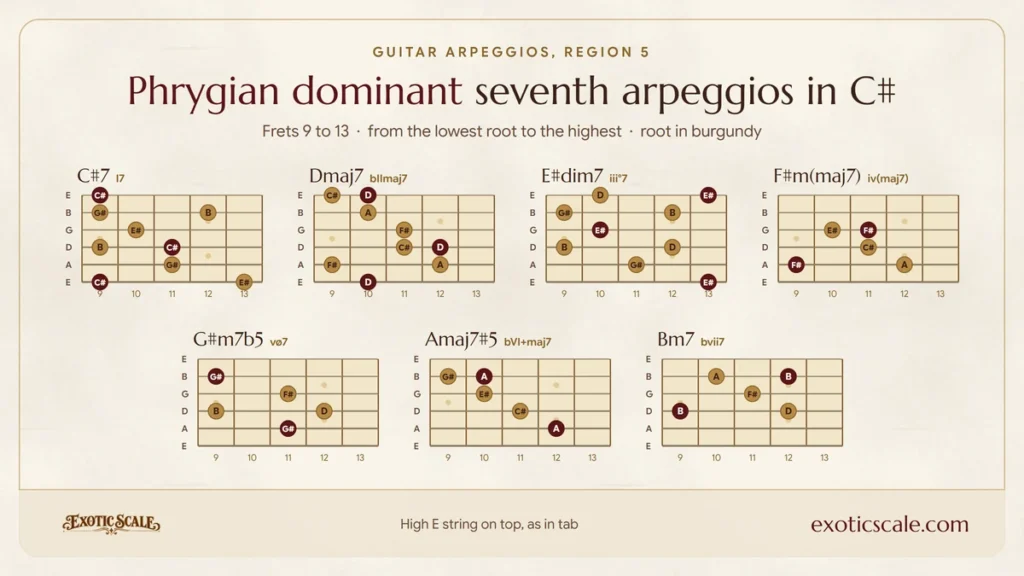
The seven Phrygian dominant seventh arpeggios in C# on guitar, region 5, frets 9 to 13, each from root to root. C#7: C# 6th string fret 9, E# 6th string fret 13, G# 5th string fret 11, B 4th string fret 9, C# 4th string fret 11, E# 3rd string fret 10, G# 2nd string fret 9, B 2nd string fret 12, C# 1st string fret 9; Dmaj7: D 6th string fret 10, F# 5th string fret 9, A 5th string fret 12, C# 4th string fret 11, D 4th string fret 12, F# 3rd string fret 11, A 2nd string fret 10, C# 1st string fret 9, D 1st string fret 10; E#dim7: E# 6th string fret 13, G# 5th string fret 11, B 4th string fret 9, D 4th string fret 12, E# 3rd string fret 10, G# 2nd string fret 9, B 2nd string fret 12, D 1st string fret 10, E# 1st string fret 13; F#m(maj7): F# 5th string fret 9, A 5th string fret 12, C# 4th string fret 11, E# 3rd string fret 10, F# 3rd string fret 11; G#m7b5: G# 5th string fret 11, B 4th string fret 9, D 4th string fret 12, F# 3rd string fret 11, G# 2nd string fret 9; Amaj7#5: A 5th string fret 12, C# 4th string fret 11, E# 3rd string fret 10, G# 2nd string fret 9, A 2nd string fret 10; Bm7: B 4th string fret 9, D 4th string fret 12, F# 3rd string fret 11, A 2nd string fret 10, B 2nd string fret 12.
Phrygian dominant seventh arpeggios in C#, region 5, frets 9 to 13: C#7, Dmaj7, E#dim7, F#m(maj7), G#m7b5, Amaj7#5, Bm7.

D Phrygian dominant arpeggios on guitar

The seven arpeggios of D Phrygian dominant start on D, Eb, F#, G, A, Bb, C. Each one is a chord of the scale played note by note: D, Eb, F#dim, Gm, Adim, Bb+, Cm as triads, D7, Ebmaj7, F#dim7, Gm(maj7), Am7b5, Bbmaj7#5, Cm7 with the 7th.

Triad and seventh arpeggios on each degree of D phrygian dominant, with their intervals
DegreeTriadNotesSeventhNotes (intervals)
IDD F# AD7D F# A C (R 3 5 b7)
bIIEbEb G BbEbmaj7Eb G Bb D (R 3 5 7)
iii°F#dimF# A CF#dim7F# A C Eb (R b3 b5 bb7)
ivGmG Bb DGm(maj7)G Bb D F# (R b3 5 7)
v°AdimA C EbAm7b5A C Eb G (R b3 b5 b7)
bVI+Bb+Bb D F#Bbmaj7#5Bb D F# A (R 3 #5 7)
bviiCmC Eb GCm7C Eb G Bb (R b3 5 b7)
The seven Phrygian dominant triad arpeggios in D on guitar, region 5, frets 9 to 13, each from root to root. D: D 6th string fret 10, F# 5th string fret 9, A 5th string fret 12, D 4th string fret 12, F# 3rd string fret 11, A 2nd string fret 10, D 1st string fret 10; Eb: Eb 6th string fret 11, G 5th string fret 10, Bb 5th string fret 13, Eb 4th string fret 13, G 3rd string fret 12, Bb 2nd string fret 11, Eb 1st string fret 11; F#dim: F# 5th string fret 9, A 5th string fret 12, C 4th string fret 10, F# 3rd string fret 11; Gm: G 5th string fret 10, Bb 5th string fret 13, D 4th string fret 12, G 3rd string fret 12; Adim: A 5th string fret 12, C 4th string fret 10, Eb 4th string fret 13, A 2nd string fret 10; Bb+: Bb 5th string fret 13, D 4th string fret 12, F# 3rd string fret 11, Bb 2nd string fret 11; Cm: C 4th string fret 10, Eb 4th string fret 13, G 3rd string fret 12, C 2nd string fret 13.
Phrygian dominant triad arpeggios in D, region 5, frets 9 to 13: D, Eb, F#dim, Gm, Adim, Bb+, Cm.
The seven Phrygian dominant seventh arpeggios in D on guitar, region 5, frets 9 to 13, each from root to root. D7: D 6th string fret 10, F# 5th string fret 9, A 5th string fret 12, C 4th string fret 10, D 4th string fret 12, F# 3rd string fret 11, A 2nd string fret 10, C 2nd string fret 13, D 1st string fret 10; Ebmaj7: Eb 6th string fret 11, G 5th string fret 10, Bb 5th string fret 13, D 4th string fret 12, Eb 4th string fret 13, G 3rd string fret 12, Bb 2nd string fret 11, D 1st string fret 10, Eb 1st string fret 11; F#dim7: F# 5th string fret 9, A 5th string fret 12, C 4th string fret 10, Eb 4th string fret 13, F# 3rd string fret 11; Gm(maj7): G 5th string fret 10, Bb 5th string fret 13, D 4th string fret 12, F# 3rd string fret 11, G 3rd string fret 12; Am7b5: A 5th string fret 12, C 4th string fret 10, Eb 4th string fret 13, G 3rd string fret 12, A 2nd string fret 10; Bbmaj7#5: Bb 5th string fret 13, D 4th string fret 12, F# 3rd string fret 11, A 2nd string fret 10, Bb 2nd string fret 11; Cm7: C 4th string fret 10, Eb 4th string fret 13, G 3rd string fret 12, Bb 2nd string fret 11, C 2nd string fret 13.
Phrygian dominant seventh arpeggios in D, region 5, frets 9 to 13: D7, Ebmaj7, F#dim7, Gm(maj7), Am7b5, Bbmaj7#5, Cm7.

Eb Phrygian dominant arpeggios on guitar

The seven arpeggios of Eb Phrygian dominant start on Eb, Fb, G, Ab, Bb, Cb, Db. Each one is a chord of the scale played note by note: Eb, Fb, Gdim, Abm, Bbdim, Cb+, Dbm as triads, Eb7, Fbmaj7, Gdim7, Abm(maj7), Bbm7b5, Cbmaj7#5, Dbm7 with the 7th.

Triad and seventh arpeggios on each degree of Eb phrygian dominant, with their intervals
DegreeTriadNotesSeventhNotes (intervals)
IEbEb G BbEb7Eb G Bb Db (R 3 5 b7)
bIIFbFb Ab CbFbmaj7Fb Ab Cb Eb (R 3 5 7)
iii°GdimG Bb DbGdim7G Bb Db Fb (R b3 b5 bb7)
ivAbmAb Cb EbAbm(maj7)Ab Cb Eb G (R b3 5 7)
v°BbdimBb Db FbBbm7b5Bb Db Fb Ab (R b3 b5 b7)
bVI+Cb+Cb Eb GCbmaj7#5Cb Eb G Bb (R 3 #5 7)
bviiDbmDb Fb AbDbm7Db Fb Ab Cb (R b3 5 b7)
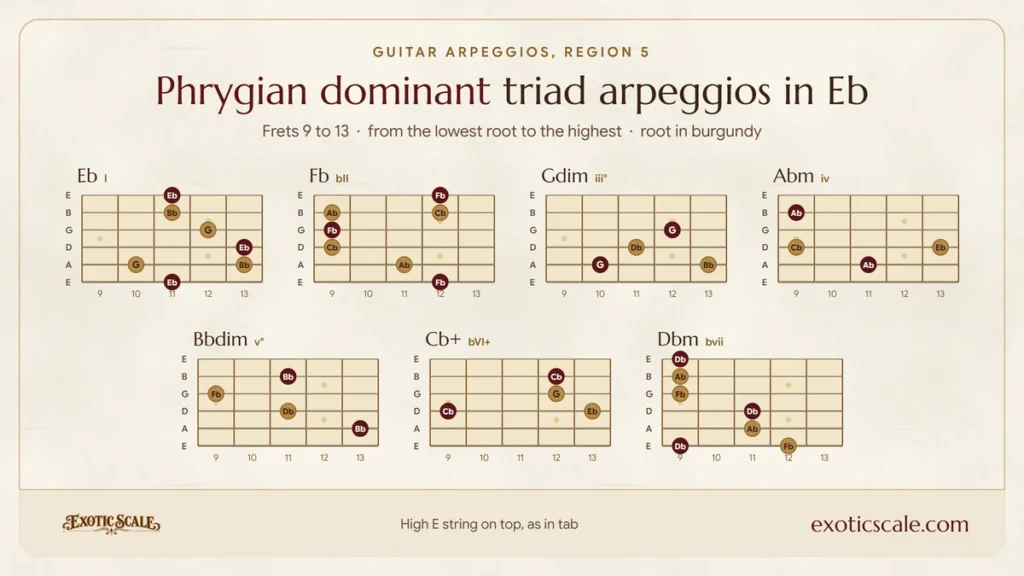
The seven Phrygian dominant triad arpeggios in Eb on guitar, region 5, frets 9 to 13, each from root to root. Eb: Eb 6th string fret 11, G 5th string fret 10, Bb 5th string fret 13, Eb 4th string fret 13, G 3rd string fret 12, Bb 2nd string fret 11, Eb 1st string fret 11; Fb: Fb 6th string fret 12, Ab 5th string fret 11, Cb 4th string fret 9, Fb 3rd string fret 9, Ab 2nd string fret 9, Cb 2nd string fret 12, Fb 1st string fret 12; Gdim: G 5th string fret 10, Bb 5th string fret 13, Db 4th string fret 11, G 3rd string fret 12; Abm: Ab 5th string fret 11, Cb 4th string fret 9, Eb 4th string fret 13, Ab 2nd string fret 9; Bbdim: Bb 5th string fret 13, Db 4th string fret 11, Fb 3rd string fret 9, Bb 2nd string fret 11; Cb+: Cb 4th string fret 9, Eb 4th string fret 13, G 3rd string fret 12, Cb 2nd string fret 12; Dbm: Db 6th string fret 9, Fb 6th string fret 12, Ab 5th string fret 11, Db 4th string fret 11, Fb 3rd string fret 9, Ab 2nd string fret 9, Db 1st string fret 9.
Phrygian dominant triad arpeggios in Eb, region 5, frets 9 to 13: Eb, Fb, Gdim, Abm, Bbdim, Cb+, Dbm.
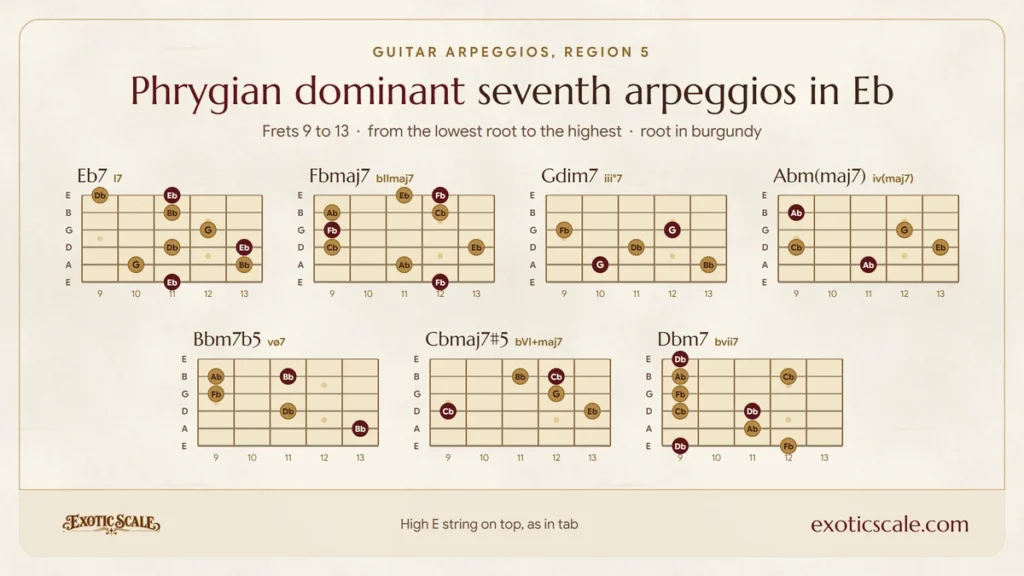
The seven Phrygian dominant seventh arpeggios in Eb on guitar, region 5, frets 9 to 13, each from root to root. Eb7: Eb 6th string fret 11, G 5th string fret 10, Bb 5th string fret 13, Db 4th string fret 11, Eb 4th string fret 13, G 3rd string fret 12, Bb 2nd string fret 11, Db 1st string fret 9, Eb 1st string fret 11; Fbmaj7: Fb 6th string fret 12, Ab 5th string fret 11, Cb 4th string fret 9, Eb 4th string fret 13, Fb 3rd string fret 9, Ab 2nd string fret 9, Cb 2nd string fret 12, Eb 1st string fret 11, Fb 1st string fret 12; Gdim7: G 5th string fret 10, Bb 5th string fret 13, Db 4th string fret 11, Fb 3rd string fret 9, G 3rd string fret 12; Abm(maj7): Ab 5th string fret 11, Cb 4th string fret 9, Eb 4th string fret 13, G 3rd string fret 12, Ab 2nd string fret 9; Bbm7b5: Bb 5th string fret 13, Db 4th string fret 11, Fb 3rd string fret 9, Ab 2nd string fret 9, Bb 2nd string fret 11; Cbmaj7#5: Cb 4th string fret 9, Eb 4th string fret 13, G 3rd string fret 12, Bb 2nd string fret 11, Cb 2nd string fret 12; Dbm7: Db 6th string fret 9, Fb 6th string fret 12, Ab 5th string fret 11, Cb 4th string fret 9, Db 4th string fret 11, Fb 3rd string fret 9, Ab 2nd string fret 9, Cb 2nd string fret 12, Db 1st string fret 9.
Phrygian dominant seventh arpeggios in Eb, region 5, frets 9 to 13: Eb7, Fbmaj7, Gdim7, Abm(maj7), Bbm7b5, Cbmaj7#5, Dbm7.

E Phrygian dominant arpeggios on guitar

The seven arpeggios of E Phrygian dominant start on E, F, G#, A, B, C, D. Each one is a chord of the scale played note by note: E, F, G#dim, Am, Bdim, C+, Dm as triads, E7, Fmaj7, G#dim7, Am(maj7), Bm7b5, Cmaj7#5, Dm7 with the 7th.

Triad and seventh arpeggios on each degree of E phrygian dominant, with their intervals
DegreeTriadNotesSeventhNotes (intervals)
IEE G# BE7E G# B D (R 3 5 b7)
bIIFF A CFmaj7F A C E (R 3 5 7)
iii°G#dimG# B DG#dim7G# B D F (R b3 b5 bb7)
ivAmA C EAm(maj7)A C E G# (R b3 5 7)
v°BdimB D FBm7b5B D F A (R b3 b5 b7)
bVI+C+C E G#Cmaj7#5C E G# B (R 3 #5 7)
bviiDmD F ADm7D F A C (R b3 5 b7)
The seven Phrygian dominant triad arpeggios in E on guitar, region 1, frets 0 to 4, each from root to root. E: E 6th string open, G# 6th string fret 4, B 5th string fret 2, E 4th string fret 2, G# 3rd string fret 1, B 2nd string open, E 1st string open; F: F 6th string fret 1, A 5th string open, C 5th string fret 3, F 4th string fret 3, A 3rd string fret 2, C 2nd string fret 1, F 1st string fret 1; G#dim: G# 6th string fret 4, B 5th string fret 2, D 4th string open, G# 3rd string fret 1, B 2nd string open, D 2nd string fret 3, G# 1st string fret 4; Am: A 5th string open, C 5th string fret 3, E 4th string fret 2, A 3rd string fret 2; Bdim: B 5th string fret 2, D 4th string open, F 4th string fret 3, B 2nd string open; C+: C 5th string fret 3, E 4th string fret 2, G# 3rd string fret 1, C 2nd string fret 1; Dm: D 4th string open, F 4th string fret 3, A 3rd string fret 2, D 2nd string fret 3.
Phrygian dominant triad arpeggios in E, region 1, frets 0 to 4: E, F, G#dim, Am, Bdim, C+, Dm.
The seven Phrygian dominant seventh arpeggios in E on guitar, region 1, frets 0 to 4, each from root to root. E7: E 6th string open, G# 6th string fret 4, B 5th string fret 2, D 4th string open, E 4th string fret 2, G# 3rd string fret 1, B 2nd string open, D 2nd string fret 3, E 1st string open; Fmaj7: F 6th string fret 1, A 5th string open, C 5th string fret 3, E 4th string fret 2, F 4th string fret 3, A 3rd string fret 2, C 2nd string fret 1, E 1st string open, F 1st string fret 1; G#dim7: G# 6th string fret 4, B 5th string fret 2, D 4th string open, F 4th string fret 3, G# 3rd string fret 1, B 2nd string open, D 2nd string fret 3, F 1st string fret 1, G# 1st string fret 4; Am(maj7): A 5th string open, C 5th string fret 3, E 4th string fret 2, G# 3rd string fret 1, A 3rd string fret 2; Bm7b5: B 5th string fret 2, D 4th string open, F 4th string fret 3, A 3rd string fret 2, B 2nd string open; Cmaj7#5: C 5th string fret 3, E 4th string fret 2, G# 3rd string fret 1, B 2nd string open, C 2nd string fret 1; Dm7: D 4th string open, F 4th string fret 3, A 3rd string fret 2, C 2nd string fret 1, D 2nd string fret 3.
Phrygian dominant seventh arpeggios in E, region 1, frets 0 to 4: E7, Fmaj7, G#dim7, Am(maj7), Bm7b5, Cmaj7#5, Dm7.

F Phrygian dominant arpeggios on guitar

The seven arpeggios of F Phrygian dominant start on F, Gb, A, Bb, C, Db, Eb. Each one is a chord of the scale played note by note: F, Gb, Adim, Bbm, Cdim, Db+, Ebm as triads, F7, Gbmaj7, Adim7, Bbm(maj7), Cm7b5, Dbmaj7#5, Ebm7 with the 7th.

Triad and seventh arpeggios on each degree of F phrygian dominant, with their intervals
DegreeTriadNotesSeventhNotes (intervals)
IFF A CF7F A C Eb (R 3 5 b7)
bIIGbGb Bb DbGbmaj7Gb Bb Db F (R 3 5 7)
iii°AdimA C EbAdim7A C Eb Gb (R b3 b5 bb7)
ivBbmBb Db FBbm(maj7)Bb Db F A (R b3 5 7)
v°CdimC Eb GbCm7b5C Eb Gb Bb (R b3 b5 b7)
bVI+Db+Db F ADbmaj7#5Db F A C (R 3 #5 7)
bviiEbmEb Gb BbEbm7Eb Gb Bb Db (R b3 5 b7)
The seven Phrygian dominant triad arpeggios in F on guitar, region 1, frets 0 to 4, each from root to root. F: F 6th string fret 1, A 5th string open, C 5th string fret 3, F 4th string fret 3, A 3rd string fret 2, C 2nd string fret 1, F 1st string fret 1; Gb: Gb 6th string fret 2, Bb 5th string fret 1, Db 5th string fret 4, Gb 4th string fret 4, Bb 3rd string fret 3, Db 2nd string fret 2, Gb 1st string fret 2; Adim: A 5th string open, C 5th string fret 3, Eb 4th string fret 1, A 3rd string fret 2; Bbm: Bb 5th string fret 1, Db 5th string fret 4, F 4th string fret 3, Bb 3rd string fret 3; Cdim: C 5th string fret 3, Eb 4th string fret 1, Gb 4th string fret 4, C 2nd string fret 1; Db+: Db 5th string fret 4, F 4th string fret 3, A 3rd string fret 2, Db 2nd string fret 2; Ebm: Eb 4th string fret 1, Gb 4th string fret 4, Bb 3rd string fret 3, Eb 2nd string fret 4.
Phrygian dominant triad arpeggios in F, region 1, frets 0 to 4: F, Gb, Adim, Bbm, Cdim, Db+, Ebm.
The seven Phrygian dominant seventh arpeggios in F on guitar, region 1, frets 0 to 4, each from root to root. F7: F 6th string fret 1, A 5th string open, C 5th string fret 3, Eb 4th string fret 1, F 4th string fret 3, A 3rd string fret 2, C 2nd string fret 1, Eb 2nd string fret 4, F 1st string fret 1; Gbmaj7: Gb 6th string fret 2, Bb 5th string fret 1, Db 5th string fret 4, F 4th string fret 3, Gb 4th string fret 4, Bb 3rd string fret 3, Db 2nd string fret 2, F 1st string fret 1, Gb 1st string fret 2; Adim7: A 5th string open, C 5th string fret 3, Eb 4th string fret 1, Gb 4th string fret 4, A 3rd string fret 2; Bbm(maj7): Bb 5th string fret 1, Db 5th string fret 4, F 4th string fret 3, A 3rd string fret 2, Bb 3rd string fret 3; Cm7b5: C 5th string fret 3, Eb 4th string fret 1, Gb 4th string fret 4, Bb 3rd string fret 3, C 2nd string fret 1; Dbmaj7#5: Db 5th string fret 4, F 4th string fret 3, A 3rd string fret 2, C 2nd string fret 1, Db 2nd string fret 2; Ebm7: Eb 4th string fret 1, Gb 4th string fret 4, Bb 3rd string fret 3, Db 2nd string fret 2, Eb 2nd string fret 4.
Phrygian dominant seventh arpeggios in F, region 1, frets 0 to 4: F7, Gbmaj7, Adim7, Bbm(maj7), Cm7b5, Dbmaj7#5, Ebm7.

F# Phrygian dominant arpeggios on guitar

The seven arpeggios of F# Phrygian dominant start on F#, G, A#, B, C#, D, E. Each one is a chord of the scale played note by note: F#, G, A#dim, Bm, C#dim, D+, Em as triads, F#7, Gmaj7, A#dim7, Bm(maj7), C#m7b5, Dmaj7#5, Em7 with the 7th.

Triad and seventh arpeggios on each degree of F# phrygian dominant, with their intervals
DegreeTriadNotesSeventhNotes (intervals)
IF#F# A# C#F#7F# A# C# E (R 3 5 b7)
bIIGG B DGmaj7G B D F# (R 3 5 7)
iii°A#dimA# C# EA#dim7A# C# E G (R b3 b5 bb7)
ivBmB D F#Bm(maj7)B D F# A# (R b3 5 7)
v°C#dimC# E GC#m7b5C# E G B (R b3 b5 b7)
bVI+D+D F# A#Dmaj7#5D F# A# C# (R 3 #5 7)
bviiEmE G BEm7E G B D (R b3 5 b7)
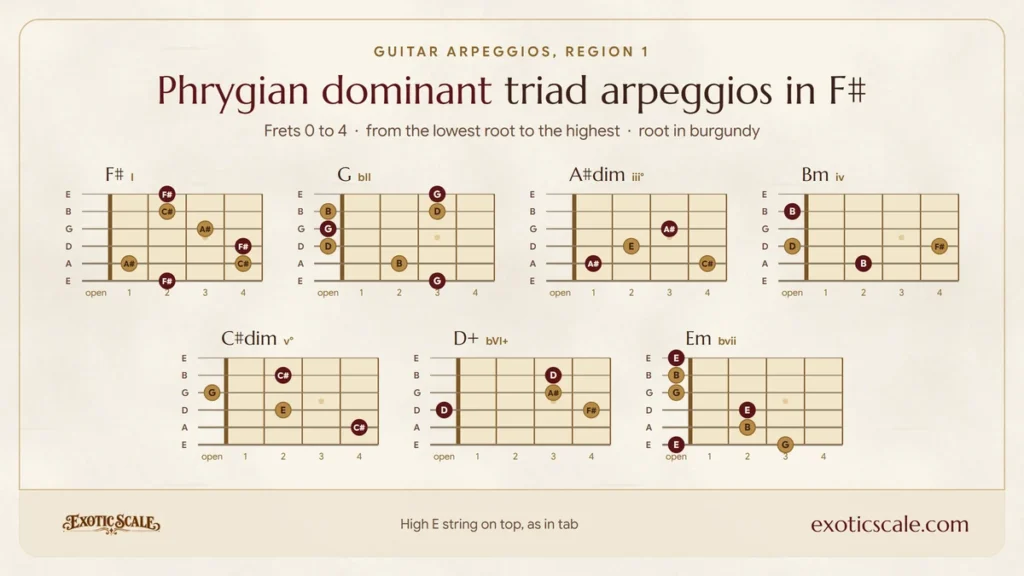
The seven Phrygian dominant triad arpeggios in F# on guitar, region 1, frets 0 to 4, each from root to root. F#: F# 6th string fret 2, A# 5th string fret 1, C# 5th string fret 4, F# 4th string fret 4, A# 3rd string fret 3, C# 2nd string fret 2, F# 1st string fret 2; G: G 6th string fret 3, B 5th string fret 2, D 4th string open, G 3rd string open, B 2nd string open, D 2nd string fret 3, G 1st string fret 3; A#dim: A# 5th string fret 1, C# 5th string fret 4, E 4th string fret 2, A# 3rd string fret 3; Bm: B 5th string fret 2, D 4th string open, F# 4th string fret 4, B 2nd string open; C#dim: C# 5th string fret 4, E 4th string fret 2, G 3rd string open, C# 2nd string fret 2; D+: D 4th string open, F# 4th string fret 4, A# 3rd string fret 3, D 2nd string fret 3; Em: E 6th string open, G 6th string fret 3, B 5th string fret 2, E 4th string fret 2, G 3rd string open, B 2nd string open, E 1st string open.
Phrygian dominant triad arpeggios in F#, region 1, frets 0 to 4: F#, G, A#dim, Bm, C#dim, D+, Em.
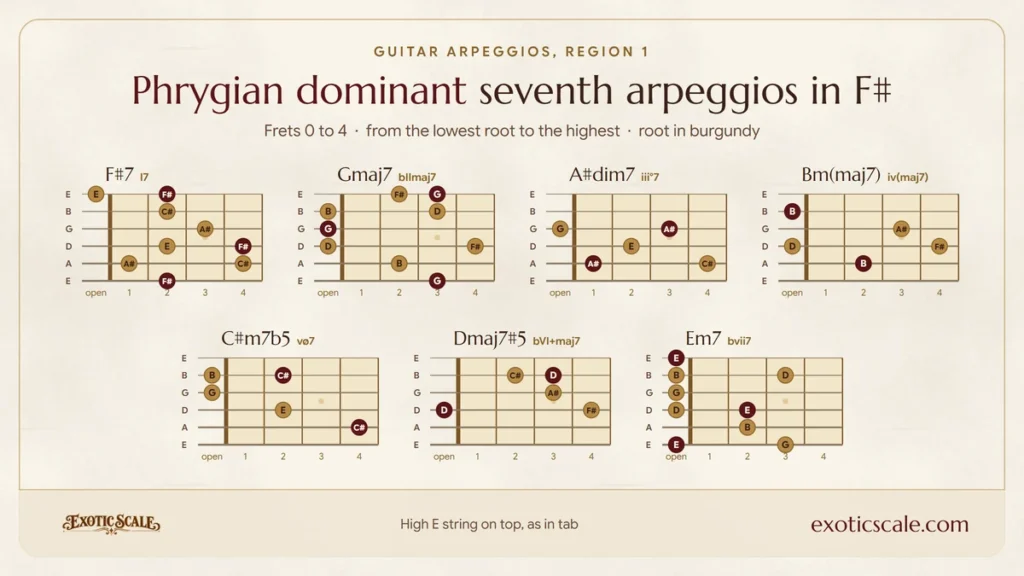
The seven Phrygian dominant seventh arpeggios in F# on guitar, region 1, frets 0 to 4, each from root to root. F#7: F# 6th string fret 2, A# 5th string fret 1, C# 5th string fret 4, E 4th string fret 2, F# 4th string fret 4, A# 3rd string fret 3, C# 2nd string fret 2, E 1st string open, F# 1st string fret 2; Gmaj7: G 6th string fret 3, B 5th string fret 2, D 4th string open, F# 4th string fret 4, G 3rd string open, B 2nd string open, D 2nd string fret 3, F# 1st string fret 2, G 1st string fret 3; A#dim7: A# 5th string fret 1, C# 5th string fret 4, E 4th string fret 2, G 3rd string open, A# 3rd string fret 3; Bm(maj7): B 5th string fret 2, D 4th string open, F# 4th string fret 4, A# 3rd string fret 3, B 2nd string open; C#m7b5: C# 5th string fret 4, E 4th string fret 2, G 3rd string open, B 2nd string open, C# 2nd string fret 2; Dmaj7#5: D 4th string open, F# 4th string fret 4, A# 3rd string fret 3, C# 2nd string fret 2, D 2nd string fret 3; Em7: E 6th string open, G 6th string fret 3, B 5th string fret 2, D 4th string open, E 4th string fret 2, G 3rd string open, B 2nd string open, D 2nd string fret 3, E 1st string open.
Phrygian dominant seventh arpeggios in F#, region 1, frets 0 to 4: F#7, Gmaj7, A#dim7, Bm(maj7), C#m7b5, Dmaj7#5, Em7.

G Phrygian dominant arpeggios on guitar

The seven arpeggios of G Phrygian dominant start on G, Ab, B, C, D, Eb, F. Each one is a chord of the scale played note by note: G, Ab, Bdim, Cm, Ddim, Eb+, Fm as triads, G7, Abmaj7, Bdim7, Cm(maj7), Dm7b5, Ebmaj7#5, Fm7 with the 7th.

Triad and seventh arpeggios on each degree of G phrygian dominant, with their intervals
DegreeTriadNotesSeventhNotes (intervals)
IGG B DG7G B D F (R 3 5 b7)
bIIAbAb C EbAbmaj7Ab C Eb G (R 3 5 7)
iii°BdimB D FBdim7B D F Ab (R b3 b5 bb7)
ivCmC Eb GCm(maj7)C Eb G B (R b3 5 7)
v°DdimD F AbDm7b5D F Ab C (R b3 b5 b7)
bVI+Eb+Eb G BEbmaj7#5Eb G B D (R 3 #5 7)
bviiFmF Ab CFm7F Ab C Eb (R b3 5 b7)
The seven Phrygian dominant triad arpeggios in G on guitar, region 2, frets 3 to 7, each from root to root. G: G 6th string fret 3, B 6th string fret 7, D 5th string fret 5, G 4th string fret 5, B 3rd string fret 4, D 2nd string fret 3, G 1st string fret 3; Ab: Ab 6th string fret 4, C 5th string fret 3, Eb 5th string fret 6, Ab 4th string fret 6, C 3rd string fret 5, Eb 2nd string fret 4, Ab 1st string fret 4; Bdim: B 6th string fret 7, D 5th string fret 5, F 4th string fret 3, B 3rd string fret 4, D 2nd string fret 3, F 2nd string fret 6, B 1st string fret 7; Cm: C 5th string fret 3, Eb 5th string fret 6, G 4th string fret 5, C 3rd string fret 5; Ddim: D 5th string fret 5, F 4th string fret 3, Ab 4th string fret 6, D 2nd string fret 3; Eb+: Eb 5th string fret 6, G 4th string fret 5, B 3rd string fret 4, Eb 2nd string fret 4; Fm: F 4th string fret 3, Ab 4th string fret 6, C 3rd string fret 5, F 2nd string fret 6.
Phrygian dominant triad arpeggios in G, region 2, frets 3 to 7: G, Ab, Bdim, Cm, Ddim, Eb+, Fm.
The seven Phrygian dominant seventh arpeggios in G on guitar, region 2, frets 3 to 7, each from root to root. G7: G 6th string fret 3, B 6th string fret 7, D 5th string fret 5, F 4th string fret 3, G 4th string fret 5, B 3rd string fret 4, D 2nd string fret 3, F 2nd string fret 6, G 1st string fret 3; Abmaj7: Ab 6th string fret 4, C 5th string fret 3, Eb 5th string fret 6, G 4th string fret 5, Ab 4th string fret 6, C 3rd string fret 5, Eb 2nd string fret 4, G 1st string fret 3, Ab 1st string fret 4; Bdim7: B 6th string fret 7, D 5th string fret 5, F 4th string fret 3, Ab 4th string fret 6, B 3rd string fret 4, D 2nd string fret 3, F 2nd string fret 6, Ab 1st string fret 4, B 1st string fret 7; Cm(maj7): C 5th string fret 3, Eb 5th string fret 6, G 4th string fret 5, B 3rd string fret 4, C 3rd string fret 5; Dm7b5: D 5th string fret 5, F 4th string fret 3, Ab 4th string fret 6, C 3rd string fret 5, D 2nd string fret 3; Ebmaj7#5: Eb 5th string fret 6, G 4th string fret 5, B 3rd string fret 4, D 2nd string fret 3, Eb 2nd string fret 4; Fm7: F 4th string fret 3, Ab 4th string fret 6, C 3rd string fret 5, Eb 2nd string fret 4, F 2nd string fret 6.
Phrygian dominant seventh arpeggios in G, region 2, frets 3 to 7: G7, Abmaj7, Bdim7, Cm(maj7), Dm7b5, Ebmaj7#5, Fm7.

G# Phrygian dominant arpeggios on guitar

The seven arpeggios of G# Phrygian dominant start on G#, A, B#, C#, D#, E, F#. Each one is a chord of the scale played note by note: G#, A, B#dim, C#m, D#dim, E+, F#m as triads, G#7, Amaj7, B#dim7, C#m(maj7), D#m7b5, Emaj7#5, F#m7 with the 7th.

Triad and seventh arpeggios on each degree of G# phrygian dominant, with their intervals
DegreeTriadNotesSeventhNotes (intervals)
IG#G# B# D#G#7G# B# D# F# (R 3 5 b7)
bIIAA C# EAmaj7A C# E G# (R 3 5 7)
iii°B#dimB# D# F#B#dim7B# D# F# A (R b3 b5 bb7)
ivC#mC# E G#C#m(maj7)C# E G# B# (R b3 5 7)
v°D#dimD# F# AD#m7b5D# F# A C# (R b3 b5 b7)
bVI+E+E G# B#Emaj7#5E G# B# D# (R 3 #5 7)
bviiF#mF# A C#F#m7F# A C# E (R b3 5 b7)
The seven Phrygian dominant triad arpeggios in G# on guitar, region 2, frets 3 to 7, each from root to root. G#: G# 6th string fret 4, B# 5th string fret 3, D# 5th string fret 6, G# 4th string fret 6, B# 3rd string fret 5, D# 2nd string fret 4, G# 1st string fret 4; A: A 6th string fret 5, C# 5th string fret 4, E 5th string fret 7, A 4th string fret 7, C# 3rd string fret 6, E 2nd string fret 5, A 1st string fret 5; B#dim: B# 5th string fret 3, D# 5th string fret 6, F# 4th string fret 4, B# 3rd string fret 5; C#m: C# 5th string fret 4, E 5th string fret 7, G# 4th string fret 6, C# 3rd string fret 6; D#dim: D# 5th string fret 6, F# 4th string fret 4, A 4th string fret 7, D# 2nd string fret 4; E+: E 5th string fret 7, G# 4th string fret 6, B# 3rd string fret 5, E 2nd string fret 5; F#m: F# 4th string fret 4, A 4th string fret 7, C# 3rd string fret 6, F# 2nd string fret 7.
Phrygian dominant triad arpeggios in G#, region 2, frets 3 to 7: G#, A, B#dim, C#m, D#dim, E+, F#m.
The seven Phrygian dominant seventh arpeggios in G# on guitar, region 2, frets 3 to 7, each from root to root. G#7: G# 6th string fret 4, B# 5th string fret 3, D# 5th string fret 6, F# 4th string fret 4, G# 4th string fret 6, B# 3rd string fret 5, D# 2nd string fret 4, F# 2nd string fret 7, G# 1st string fret 4; Amaj7: A 6th string fret 5, C# 5th string fret 4, E 5th string fret 7, G# 4th string fret 6, A 4th string fret 7, C# 3rd string fret 6, E 2nd string fret 5, G# 1st string fret 4, A 1st string fret 5; B#dim7: B# 5th string fret 3, D# 5th string fret 6, F# 4th string fret 4, A 4th string fret 7, B# 3rd string fret 5; C#m(maj7): C# 5th string fret 4, E 5th string fret 7, G# 4th string fret 6, B# 3rd string fret 5, C# 3rd string fret 6; D#m7b5: D# 5th string fret 6, F# 4th string fret 4, A 4th string fret 7, C# 3rd string fret 6, D# 2nd string fret 4; Emaj7#5: E 5th string fret 7, G# 4th string fret 6, B# 3rd string fret 5, D# 2nd string fret 4, E 2nd string fret 5; F#m7: F# 4th string fret 4, A 4th string fret 7, C# 3rd string fret 6, E 2nd string fret 5, F# 2nd string fret 7.
Phrygian dominant seventh arpeggios in G#, region 2, frets 3 to 7: G#7, Amaj7, B#dim7, C#m(maj7), D#m7b5, Emaj7#5, F#m7.

A Phrygian dominant arpeggios on guitar

The seven arpeggios of A Phrygian dominant start on A, Bb, C#, D, E, F, G. Each one is a chord of the scale played note by note: A, Bb, C#dim, Dm, Edim, F+, Gm as triads, A7, Bbmaj7, C#dim7, Dm(maj7), Em7b5, Fmaj7#5, Gm7 with the 7th.

Triad and seventh arpeggios on each degree of A phrygian dominant, with their intervals
DegreeTriadNotesSeventhNotes (intervals)
IAA C# EA7A C# E G (R 3 5 b7)
bIIBbBb D FBbmaj7Bb D F A (R 3 5 7)
iii°C#dimC# E GC#dim7C# E G Bb (R b3 b5 bb7)
ivDmD F ADm(maj7)D F A C# (R b3 5 7)
v°EdimE G BbEm7b5E G Bb D (R b3 b5 b7)
bVI+F+F A C#Fmaj7#5F A C# E (R 3 #5 7)
bviiGmG Bb DGm7G Bb D F (R b3 5 b7)
The seven Phrygian dominant triad arpeggios in A on guitar, region 3, frets 5 to 9, each from root to root. A: A 6th string fret 5, C# 6th string fret 9, E 5th string fret 7, A 4th string fret 7, C# 3rd string fret 6, E 2nd string fret 5, A 1st string fret 5; Bb: Bb 6th string fret 6, D 5th string fret 5, F 5th string fret 8, Bb 4th string fret 8, D 3rd string fret 7, F 2nd string fret 6, Bb 1st string fret 6; C#dim: C# 6th string fret 9, E 5th string fret 7, G 4th string fret 5, C# 3rd string fret 6, E 2nd string fret 5, G 2nd string fret 8, C# 1st string fret 9; Dm: D 5th string fret 5, F 5th string fret 8, A 4th string fret 7, D 3rd string fret 7; Edim: E 5th string fret 7, G 4th string fret 5, Bb 4th string fret 8, E 2nd string fret 5; F+: F 5th string fret 8, A 4th string fret 7, C# 3rd string fret 6, F 2nd string fret 6; Gm: G 4th string fret 5, Bb 4th string fret 8, D 3rd string fret 7, G 2nd string fret 8.
Phrygian dominant triad arpeggios in A, region 3, frets 5 to 9: A, Bb, C#dim, Dm, Edim, F+, Gm.
The seven Phrygian dominant seventh arpeggios in A on guitar, region 3, frets 5 to 9, each from root to root. A7: A 6th string fret 5, C# 6th string fret 9, E 5th string fret 7, G 4th string fret 5, A 4th string fret 7, C# 3rd string fret 6, E 2nd string fret 5, G 2nd string fret 8, A 1st string fret 5; Bbmaj7: Bb 6th string fret 6, D 5th string fret 5, F 5th string fret 8, A 4th string fret 7, Bb 4th string fret 8, D 3rd string fret 7, F 2nd string fret 6, A 1st string fret 5, Bb 1st string fret 6; C#dim7: C# 6th string fret 9, E 5th string fret 7, G 4th string fret 5, Bb 4th string fret 8, C# 3rd string fret 6, E 2nd string fret 5, G 2nd string fret 8, Bb 1st string fret 6, C# 1st string fret 9; Dm(maj7): D 5th string fret 5, F 5th string fret 8, A 4th string fret 7, C# 3rd string fret 6, D 3rd string fret 7; Em7b5: E 5th string fret 7, G 4th string fret 5, Bb 4th string fret 8, D 3rd string fret 7, E 2nd string fret 5; Fmaj7#5: F 5th string fret 8, A 4th string fret 7, C# 3rd string fret 6, E 2nd string fret 5, F 2nd string fret 6; Gm7: G 4th string fret 5, Bb 4th string fret 8, D 3rd string fret 7, F 2nd string fret 6, G 2nd string fret 8.
Phrygian dominant seventh arpeggios in A, region 3, frets 5 to 9: A7, Bbmaj7, C#dim7, Dm(maj7), Em7b5, Fmaj7#5, Gm7.

Bb Phrygian dominant arpeggios on guitar

The seven arpeggios of Bb Phrygian dominant start on Bb, Cb, D, Eb, F, Gb, Ab. Each one is a chord of the scale played note by note: Bb, Cb, Ddim, Ebm, Fdim, Gb+, Abm as triads, Bb7, Cbmaj7, Ddim7, Ebm(maj7), Fm7b5, Gbmaj7#5, Abm7 with the 7th.

Triad and seventh arpeggios on each degree of Bb phrygian dominant, with their intervals
DegreeTriadNotesSeventhNotes (intervals)
IBbBb D FBb7Bb D F Ab (R 3 5 b7)
bIICbCb Eb GbCbmaj7Cb Eb Gb Bb (R 3 5 7)
iii°DdimD F AbDdim7D F Ab Cb (R b3 b5 bb7)
ivEbmEb Gb BbEbm(maj7)Eb Gb Bb D (R b3 5 7)
v°FdimF Ab CbFm7b5F Ab Cb Eb (R b3 b5 b7)
bVI+Gb+Gb Bb DGbmaj7#5Gb Bb D F (R 3 #5 7)
bviiAbmAb Cb EbAbm7Ab Cb Eb Gb (R b3 5 b7)
The seven Phrygian dominant triad arpeggios in Bb on guitar, region 3, frets 5 to 9, each from root to root. Bb: Bb 6th string fret 6, D 5th string fret 5, F 5th string fret 8, Bb 4th string fret 8, D 3rd string fret 7, F 2nd string fret 6, Bb 1st string fret 6; Cb: Cb 6th string fret 7, Eb 5th string fret 6, Gb 5th string fret 9, Cb 4th string fret 9, Eb 3rd string fret 8, Gb 2nd string fret 7, Cb 1st string fret 7; Ddim: D 5th string fret 5, F 5th string fret 8, Ab 4th string fret 6, D 3rd string fret 7; Ebm: Eb 5th string fret 6, Gb 5th string fret 9, Bb 4th string fret 8, Eb 3rd string fret 8; Fdim: F 5th string fret 8, Ab 4th string fret 6, Cb 4th string fret 9, F 2nd string fret 6; Gb+: Gb 5th string fret 9, Bb 4th string fret 8, D 3rd string fret 7, Gb 2nd string fret 7; Abm: Ab 4th string fret 6, Cb 4th string fret 9, Eb 3rd string fret 8, Ab 2nd string fret 9.
Phrygian dominant triad arpeggios in Bb, region 3, frets 5 to 9: Bb, Cb, Ddim, Ebm, Fdim, Gb+, Abm.
The seven Phrygian dominant seventh arpeggios in Bb on guitar, region 3, frets 5 to 9, each from root to root. Bb7: Bb 6th string fret 6, D 5th string fret 5, F 5th string fret 8, Ab 4th string fret 6, Bb 4th string fret 8, D 3rd string fret 7, F 2nd string fret 6, Ab 2nd string fret 9, Bb 1st string fret 6; Cbmaj7: Cb 6th string fret 7, Eb 5th string fret 6, Gb 5th string fret 9, Bb 4th string fret 8, Cb 4th string fret 9, Eb 3rd string fret 8, Gb 2nd string fret 7, Bb 1st string fret 6, Cb 1st string fret 7; Ddim7: D 5th string fret 5, F 5th string fret 8, Ab 4th string fret 6, Cb 4th string fret 9, D 3rd string fret 7; Ebm(maj7): Eb 5th string fret 6, Gb 5th string fret 9, Bb 4th string fret 8, D 3rd string fret 7, Eb 3rd string fret 8; Fm7b5: F 5th string fret 8, Ab 4th string fret 6, Cb 4th string fret 9, Eb 3rd string fret 8, F 2nd string fret 6; Gbmaj7#5: Gb 5th string fret 9, Bb 4th string fret 8, D 3rd string fret 7, F 2nd string fret 6, Gb 2nd string fret 7; Abm7: Ab 4th string fret 6, Cb 4th string fret 9, Eb 3rd string fret 8, Gb 2nd string fret 7, Ab 2nd string fret 9.
Phrygian dominant seventh arpeggios in Bb, region 3, frets 5 to 9: Bb7, Cbmaj7, Ddim7, Ebm(maj7), Fm7b5, Gbmaj7#5, Abm7.

B Phrygian dominant arpeggios on guitar

The seven arpeggios of B Phrygian dominant start on B, C, D#, E, F#, G, A. Each one is a chord of the scale played note by note: B, C, D#dim, Em, F#dim, G+, Am as triads, B7, Cmaj7, D#dim7, Em(maj7), F#m7b5, Gmaj7#5, Am7 with the 7th.

Triad and seventh arpeggios on each degree of B phrygian dominant, with their intervals
DegreeTriadNotesSeventhNotes (intervals)
IBB D# F#B7B D# F# A (R 3 5 b7)
bIICC E GCmaj7C E G B (R 3 5 7)
iii°D#dimD# F# AD#dim7D# F# A C (R b3 b5 bb7)
ivEmE G BEm(maj7)E G B D# (R b3 5 7)
v°F#dimF# A CF#m7b5F# A C E (R b3 b5 b7)
bVI+G+G B D#Gmaj7#5G B D# F# (R 3 #5 7)
bviiAmA C EAm7A C E G (R b3 5 b7)
The seven Phrygian dominant triad arpeggios in B on guitar, region 4, frets 7 to 11, each from root to root. B: B 6th string fret 7, D# 6th string fret 11, F# 5th string fret 9, B 4th string fret 9, D# 3rd string fret 8, F# 2nd string fret 7, B 1st string fret 7; C: C 6th string fret 8, E 5th string fret 7, G 5th string fret 10, C 4th string fret 10, E 3rd string fret 9, G 2nd string fret 8, C 1st string fret 8; D#dim: D# 6th string fret 11, F# 5th string fret 9, A 4th string fret 7, D# 3rd string fret 8, F# 2nd string fret 7, A 2nd string fret 10, D# 1st string fret 11; Em: E 5th string fret 7, G 5th string fret 10, B 4th string fret 9, E 3rd string fret 9; F#dim: F# 5th string fret 9, A 4th string fret 7, C 4th string fret 10, F# 2nd string fret 7; G+: G 5th string fret 10, B 4th string fret 9, D# 3rd string fret 8, G 2nd string fret 8; Am: A 4th string fret 7, C 4th string fret 10, E 3rd string fret 9, A 2nd string fret 10.
Phrygian dominant triad arpeggios in B, region 4, frets 7 to 11: B, C, D#dim, Em, F#dim, G+, Am.
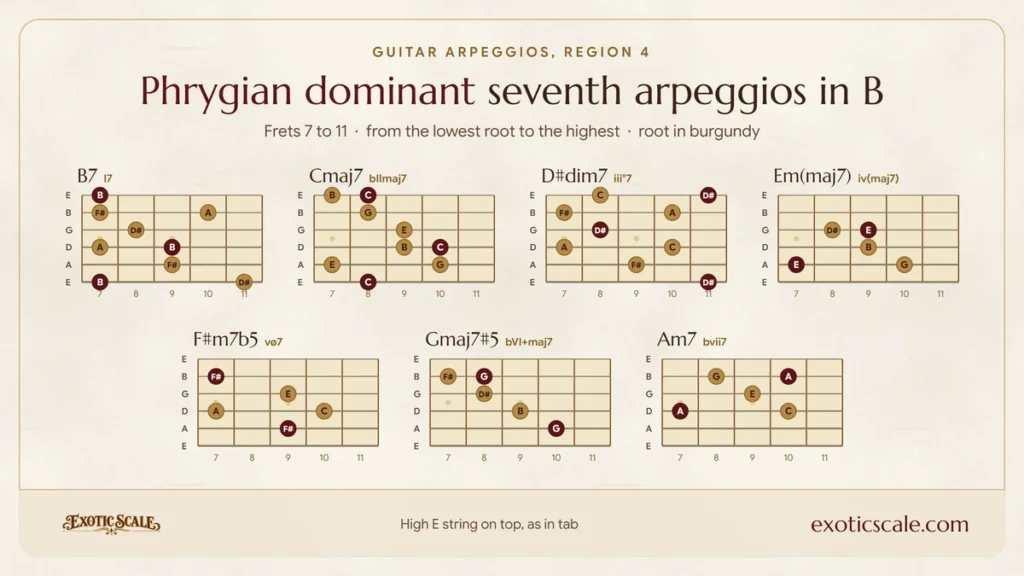
The seven Phrygian dominant seventh arpeggios in B on guitar, region 4, frets 7 to 11, each from root to root. B7: B 6th string fret 7, D# 6th string fret 11, F# 5th string fret 9, A 4th string fret 7, B 4th string fret 9, D# 3rd string fret 8, F# 2nd string fret 7, A 2nd string fret 10, B 1st string fret 7; Cmaj7: C 6th string fret 8, E 5th string fret 7, G 5th string fret 10, B 4th string fret 9, C 4th string fret 10, E 3rd string fret 9, G 2nd string fret 8, B 1st string fret 7, C 1st string fret 8; D#dim7: D# 6th string fret 11, F# 5th string fret 9, A 4th string fret 7, C 4th string fret 10, D# 3rd string fret 8, F# 2nd string fret 7, A 2nd string fret 10, C 1st string fret 8, D# 1st string fret 11; Em(maj7): E 5th string fret 7, G 5th string fret 10, B 4th string fret 9, D# 3rd string fret 8, E 3rd string fret 9; F#m7b5: F# 5th string fret 9, A 4th string fret 7, C 4th string fret 10, E 3rd string fret 9, F# 2nd string fret 7; Gmaj7#5: G 5th string fret 10, B 4th string fret 9, D# 3rd string fret 8, F# 2nd string fret 7, G 2nd string fret 8; Am7: A 4th string fret 7, C 4th string fret 10, E 3rd string fret 9, G 2nd string fret 8, A 2nd string fret 10.
Phrygian dominant seventh arpeggios in B, region 4, frets 7 to 11: B7, Cmaj7, D#dim7, Em(maj7), F#m7b5, Gmaj7#5, Am7.

Phrygian Dominant Arpeggios on Guitar: frequently asked questions

Short answers to the questions guitarists ask most about the Phrygian dominant arpeggios on guitar.

What are the arpeggios of the Phrygian dominant scale?

They are the chords of the scale played note by note. In E the triad arpeggios are E, F, G#dim, Am, Bdim, C+ and Dm; with the 7th they are E7, Fmaj7, G#dim7, Am(maj7), Bm7b5, Cmaj7#5 and Dm7. The same qualities sit on the same degrees in every key.

Which arpeggio sounds most like the Phrygian dominant?

The home arpeggio, E7 in E: E G# B D. Its major 3rd G# against the scale's F, a half step above the root, is the sound of the scale. The G#dim7 arpeggio, G# B D F, played over E7 adds the b9 (F) and gives the E7b9 colour.

What is the difference between vertical and horizontal arpeggios on guitar?

A vertical arpeggio stays in one neck region and crosses the strings, so the hand does not move along the neck. A horizontal arpeggio starts on the root of one string and travels up the neck with two or three notes per string.

How do I practise Phrygian dominant arpeggios on guitar?

Start with E7 and F in one region, from root to root, slowly with the tempo low. Then play the seven arpeggios of the key in order in the same region, and finally the horizontal version from the 6th, 5th and 4th string.