
What is the harmonic minor scale?
The natural minor scale with one note raised:
the 7th moves up a half step, next to the root.
The harmonic minor scale is a seven-note scale built from the formula 1 2 b3 4 5 b6 7. Start from A natural minor, A B C D E F G, raise the G to G#, and you get A harmonic minor: A B C D E F G#.
That one change does two things. The G# sits a half step under the root and pulls up to it, the way the 7th of a major scale does; music theory calls it the leading tone. And it opens a wide gap between F and G#, a step and a half, the sound most people call classical, dramatic or Middle Eastern.
Harmonic minor formula, steps and intervals
Seven notes, six ordinary steps
and one wide step of a tone and a half.
Formula: 1 2 b3 4 5 b6 7
Steps in tones: 1 ½ 1 1 ½ 1½ ½ (whole, half, whole, whole, half, augmented second, half; often written W H W W H A H)
Semitones from the root: 0 2 3 5 7 8 11
Harmonic minor intervals in A
1, root: A
2, major second: B
b3, minor third: C
4, perfect fourth: D
5, perfect fifth: E
b6, minor sixth: F
7, major seventh: G#
The augmented second, signature of harmonic minor
Between the b6 and the 7 there is a step of one and a half tones: F to G# in A. It is written as a second, because F and G are neighbouring letters, but it sounds as wide as a minor third. Composers of the 18th century found it awkward to sing, which is why the melodic minor raises the 6th as well on the way up.
Harmonic minor compared with natural and melodic minor
Three minor scales share the same first five notes;
they differ only in the 6th and the 7th.
Natural minor keeps both low: A B C D E F G. Harmonic minor raises the 7th: A B C D E F G#. Melodic minor raises the 6th and the 7th on the way up: A B C D E F# G#. Each change makes the top of the scale brighter and pulls harder to the root.
In practice, songs in a minor key often use natural minor over the minor chords and harmonic minor over the V chord. In A minor that means G over Am and Dm, and G# over E or E7, the chord that leads home.
Harmonic minor is also the parent of seven modes. Start it on the 5th note and you get Phrygian dominant, the scale of flamenco and Hijaz melodies: A harmonic minor from E is E Phrygian dominant, so the two scales share every note and differ only in which note feels like home.
Other names: Aeolian natural 7, Kiravani and Nahawand
The same seven notes appear in several traditions,
sometimes with the same pitches, sometimes only close to them.
Aeolian natural 7 (Aeolian #7): Western theory, the Aeolian mode with a raised 7th
Kiravani: the 21st melakarta of Carnatic music, with the same pitches
Nahawand: an Arabic maqam that often rises like harmonic minor and falls like natural minor
Mohammedan scale: an old Western name, found in older scale lists
Is maqam Nahawand the same as harmonic minor?
Close, not the same. Maqam Nahawand starts with jins Nahawand on the tonic and often places jins Hijaz on its 5th degree, which gives the raised 7th on the way up; on the way down it usually takes the lower 7th, like natural minor. Its intervals are also tuned by ear, not to a piano, so on a fretted guitar harmonic minor is an approximation.
How the harmonic minor scale sounds
Dark at the bottom, tense at the top:
press Play and listen for the jump from F to G#.
- A1
- B2
- Cb3
- D4
- E5
- Fb6
- G#7
Three notes shape the sound. The minor 3rd, C in A, makes the scale minor. The b6, F, sits a half step above the 5th and tends to fall onto it, which gives sad, sighing lines. The 7th, G#, sits a half step under the root and pulls up to it, which gives the strong sense of arrival at the end of a phrase.
Try it on any instrument: play A, then G#, then A again. That half step under the root is the quickest way into the sound of the scale.
Harmonic minor guitar basics in A and E
On the guitar the scale sits most naturally in A and E,
the two keys whose roots are open bass strings.
A harmonic minor and the open strings
A harmonic minor is A B C D E F G#. The open E, A, D, B and high E strings all belong to it; only the open G string does not, because the scale has G#. With the root on the open 5th string, the whole first position rings.
E harmonic minor and the open strings
E harmonic minor is E F# G A B C D#. The open E, A, G, B and high E strings belong to it; the open D string does not, because the scale has D#. The root sits on the open 6th string.
How to start practising harmonic minor on guitar
1. Play the scale on the A string alone, from the open string to the 12th fret, and say the degree of each note.
2. Play it slowly over an A drone and stop on G# to hear it pull to the root.
3. Learn the open position in A, then the five neck regions.
4. Strum Am, Dm and E, then play the scale over the E chord.
Where the harmonic minor scale is used
From Baroque cadences to neoclassical metal:
wherever a minor key needs a strong V chord.
You hear it in the minor-key harmony of classical music, where the major V and the diminished vii° chord come from it; in neoclassical metal, where Ritchie Blackmore, Uli Jon Roth and Michael Schenker took classical lines into rock and Yngwie Malmsteen made the scale its signature sound; in Carnatic music as raga Kiravani; and as an approximation of maqam Nahawand in Arabic music.
In pop and rock songs it usually appears over one chord: the V of a minor key. Lessons point to the solo of Santana's Smooth, where the guitar plays A harmonic minor over the E7, and to the F#7 of Hotel California by the Eagles. On this site we name a song only when three sources agree on how it uses the scale.
Harmonic minor chords in A
One chord on each degree of A harmonic minor: its triad, its seventh chord and their notes.
| Degree | Triad | Seventh chord | Seventh chord notes |
|---|---|---|---|
| i | Am | Am(maj7) | A C E G# |
| ii° | Bdim | Bm7b5 | B D F A |
| bIII+ | C+ | Cmaj7#5 | C E G# B |
| iv | Dm | Dm7 | D F A C |
| V | E | E7 | E G# B D |
| bVI | F | Fmaj7 | F A C E |
| vii° | G#dim | G#dim7 | G# B D F |
Harmonic minor scale in all 12 keys
The seven notes of the harmonic minor scale in every key, spelled from its formula, then one card per key.
| Key | 1 | 2 | b3 | 4 | 5 | b6 | 7 |
|---|---|---|---|---|---|---|---|
| C | C | D | Eb | F | G | Ab | B |
| C# | C# | D# | E | F# | G# | A | B# |
| D | D | E | F | G | A | Bb | C# |
| Eb | Eb | F | Gb | Ab | Bb | Cb | D |
| E | E | F# | G | A | B | C | D# |
| F | F | G | Ab | Bb | C | Db | E |
| F# | F# | G# | A | B | C# | D | E# |
| G | G | A | Bb | C | D | Eb | F# |
| G# | G# | A# | B | C# | D# | E | F## |
| A | A | B | C | D | E | F | G# |
| Bb | Bb | C | Db | Eb | F | Gb | A |
| B | B | C# | D | E | F# | G | A# |
C harmonic minor scale
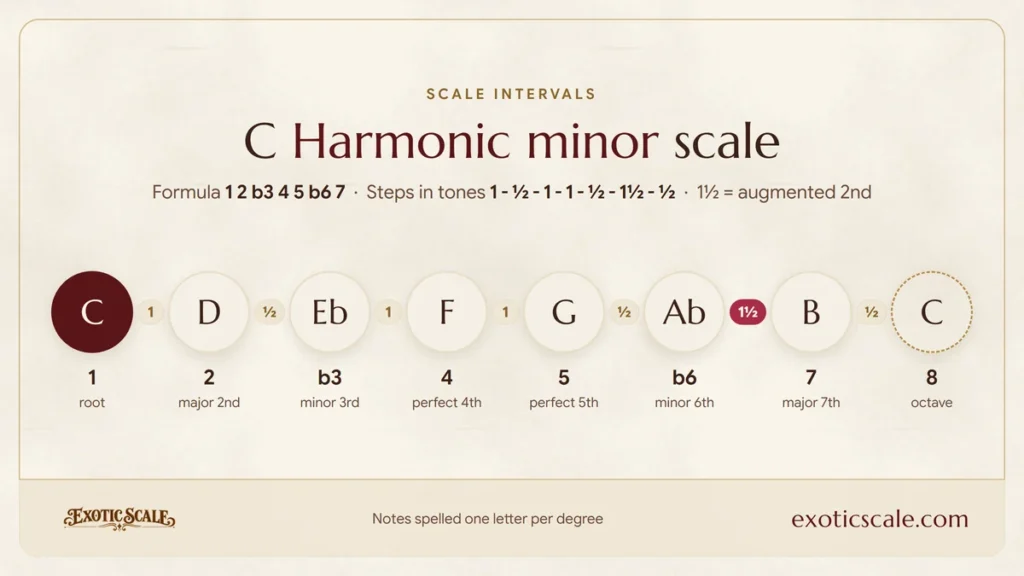
C harmonic minor is C D Eb F G Ab B. It is written with 2 flats (Eb, Ab). The augmented 2nd runs from Ab to B. In the harmonic minor scale, its raised 7th, B, sits a half step under the root, so the V chord G is major and leads home to Cm.
C# harmonic minor scale
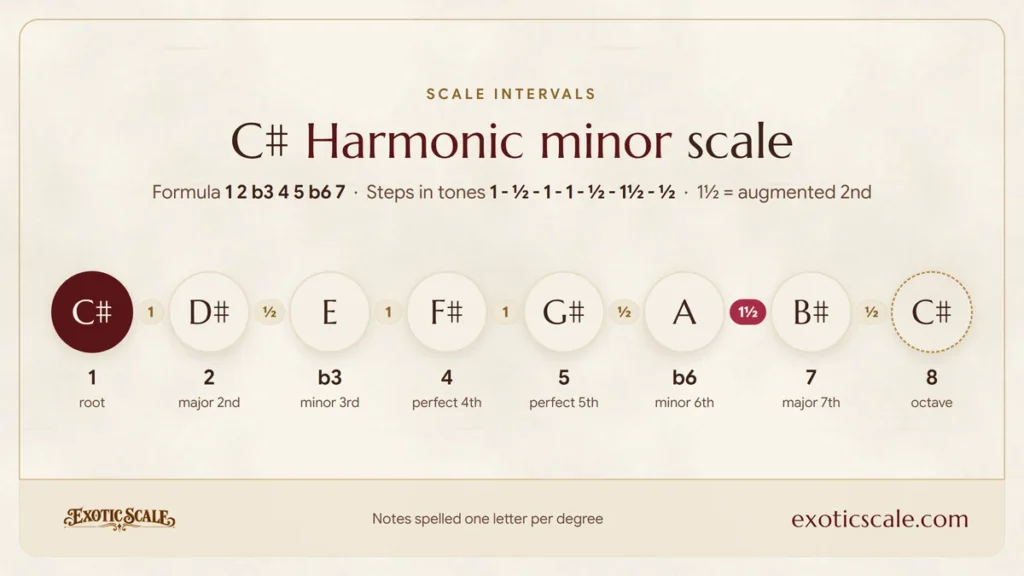
C# harmonic minor is C# D# E F# G# A B#. It is written with 5 sharps (C#, D#, F#, G#, B#). The augmented 2nd runs from A to B#. In the harmonic minor scale, its raised 7th, B#, sits a half step under the root, so the V chord G# is major and leads home to C#m.
D harmonic minor scale
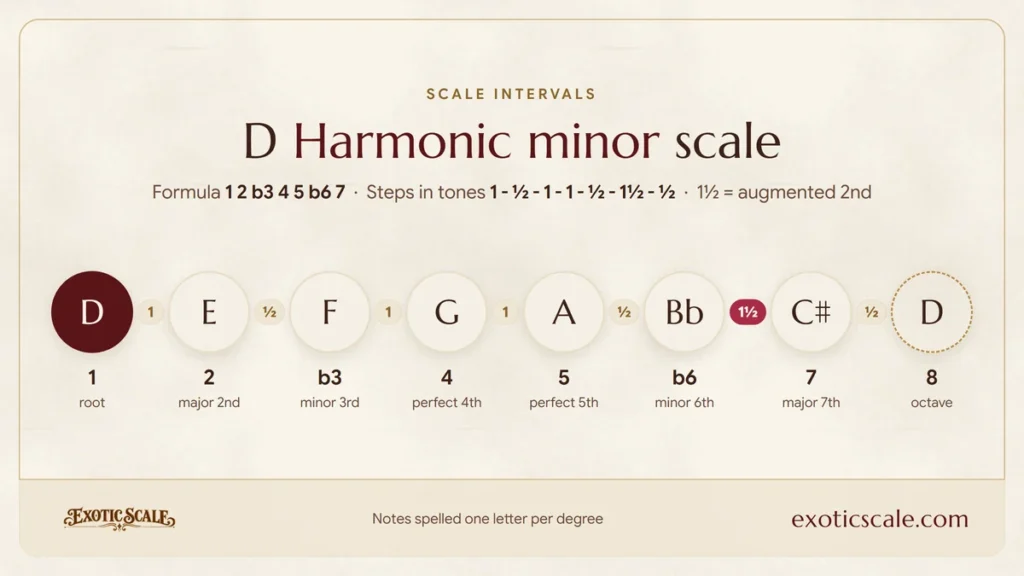
D harmonic minor is D E F G A Bb C#. It is written with 1 sharp (C#) and 1 flat (Bb). The augmented 2nd runs from Bb to C#. In the harmonic minor scale, its raised 7th, C#, sits a half step under the root, so the V chord A is major and leads home to Dm.
Eb harmonic minor scale
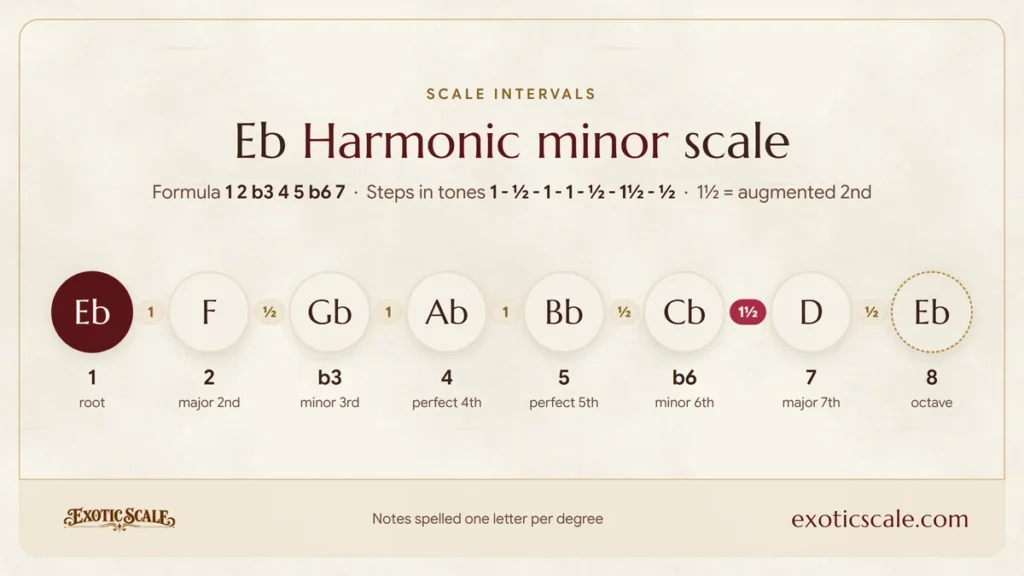
Eb harmonic minor is Eb F Gb Ab Bb Cb D. It is written with 5 flats (Eb, Gb, Ab, Bb, Cb). The augmented 2nd runs from Cb to D. In the harmonic minor scale, its raised 7th, D, sits a half step under the root, so the V chord Bb is major and leads home to Ebm.
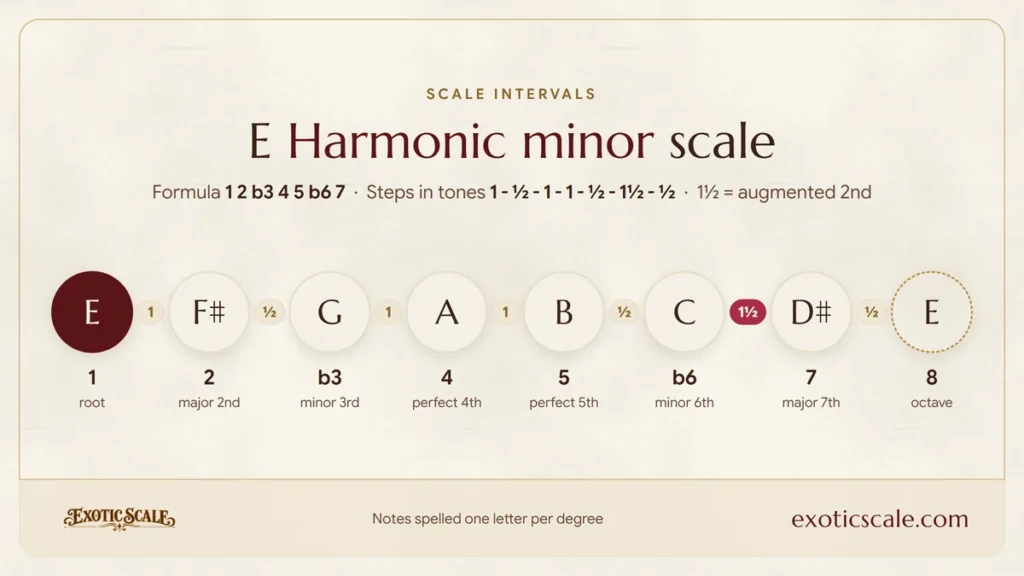
E harmonic minor scale
E harmonic minor is E F# G A B C D#. It is written with 2 sharps (F#, D#). The augmented 2nd runs from C to D#. In the harmonic minor scale, its raised 7th, D#, sits a half step under the root, so the V chord B is major and leads home to Em.
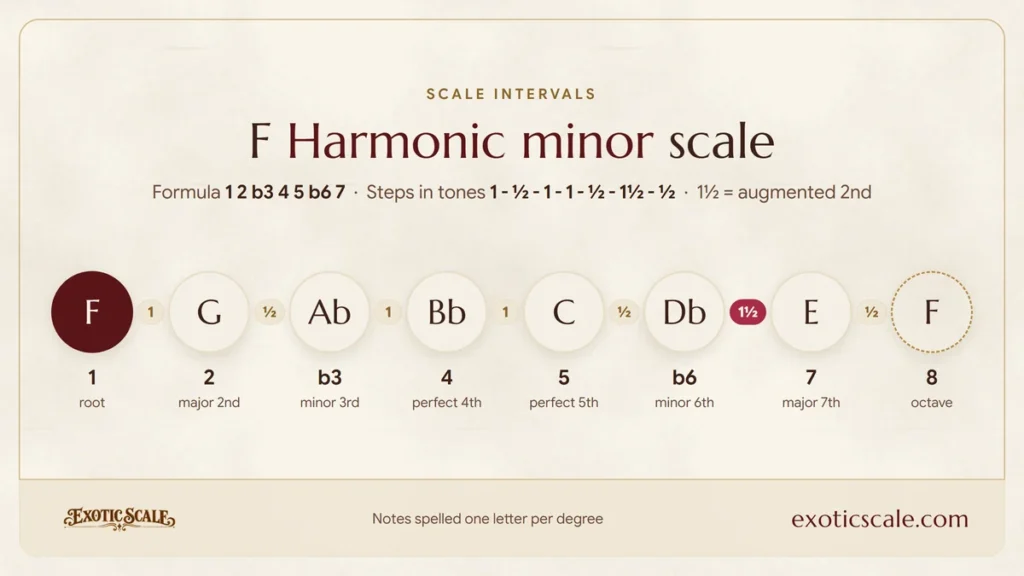
F harmonic minor scale
F harmonic minor is F G Ab Bb C Db E. It is written with 3 flats (Ab, Bb, Db). The augmented 2nd runs from Db to E. In the harmonic minor scale, its raised 7th, E, sits a half step under the root, so the V chord C is major and leads home to Fm.
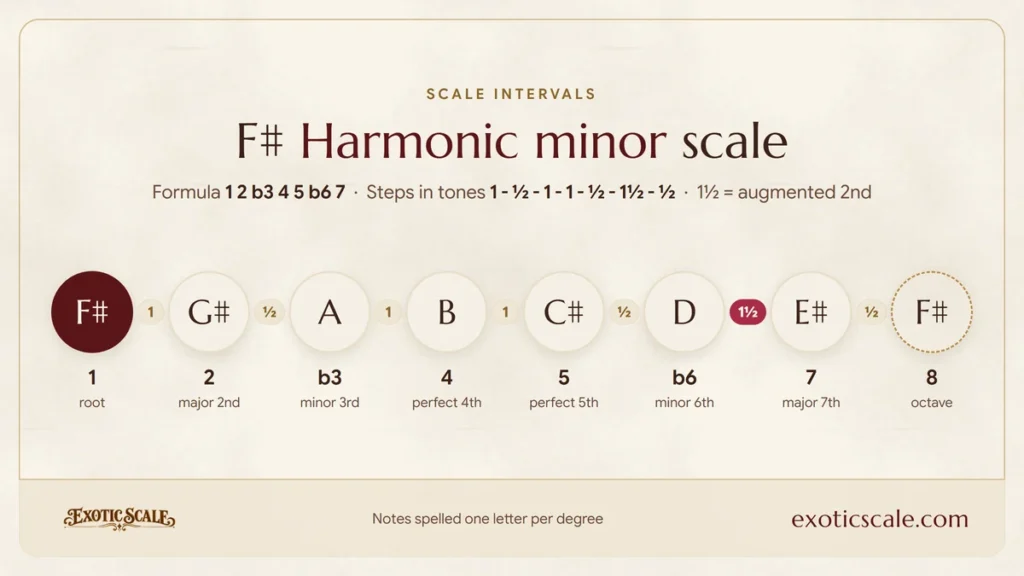
F# harmonic minor scale
F# harmonic minor is F# G# A B C# D E#. It is written with 4 sharps (F#, G#, C#, E#). The augmented 2nd runs from D to E#. In the harmonic minor scale, its raised 7th, E#, sits a half step under the root, so the V chord C# is major and leads home to F#m.
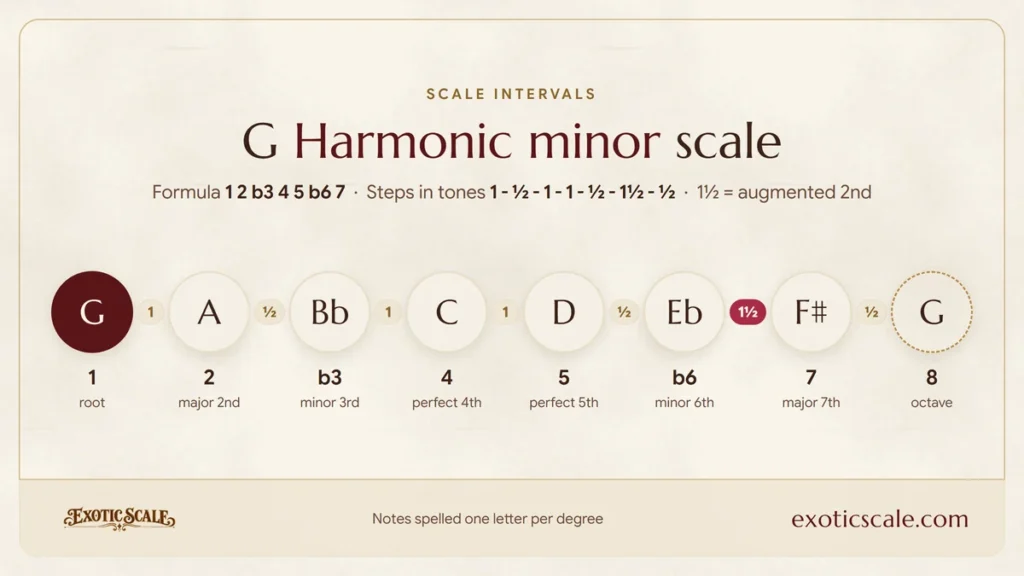
G harmonic minor scale
G harmonic minor is G A Bb C D Eb F#. It is written with 1 sharp (F#) and 2 flats (Bb, Eb). The augmented 2nd runs from Eb to F#. In the harmonic minor scale, its raised 7th, F#, sits a half step under the root, so the V chord D is major and leads home to Gm.
G# harmonic minor scale
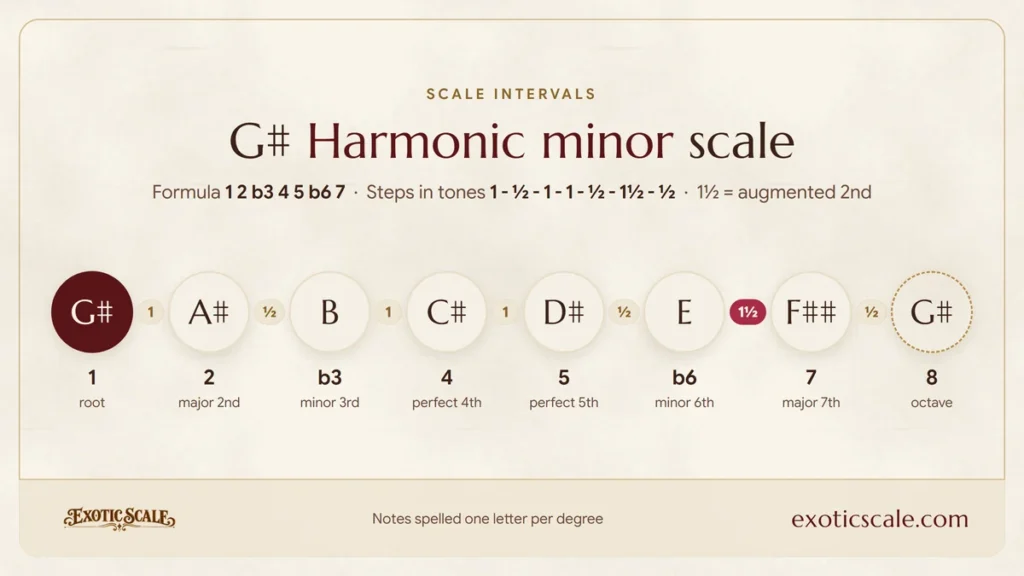
G# harmonic minor is G# A# B C# D# E F##. It is written with 4 sharps (G#, A#, C#, D#) and 1 double sharp (F##). The augmented 2nd runs from E to F##. In the harmonic minor scale, its raised 7th, F##, sits a half step under the root, so the V chord D# is major and leads home to G#m.
A harmonic minor scale
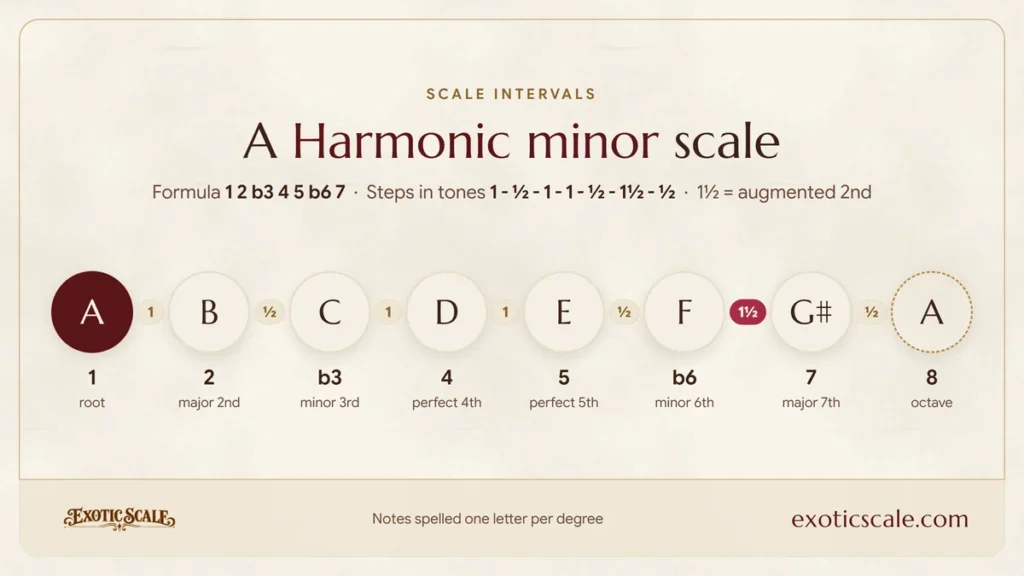
A harmonic minor is A B C D E F G#. It is written with 1 sharp (G#). The augmented 2nd runs from F to G#. In the harmonic minor scale, its raised 7th, G#, sits a half step under the root, so the V chord E is major and leads home to Am.
Bb harmonic minor scale
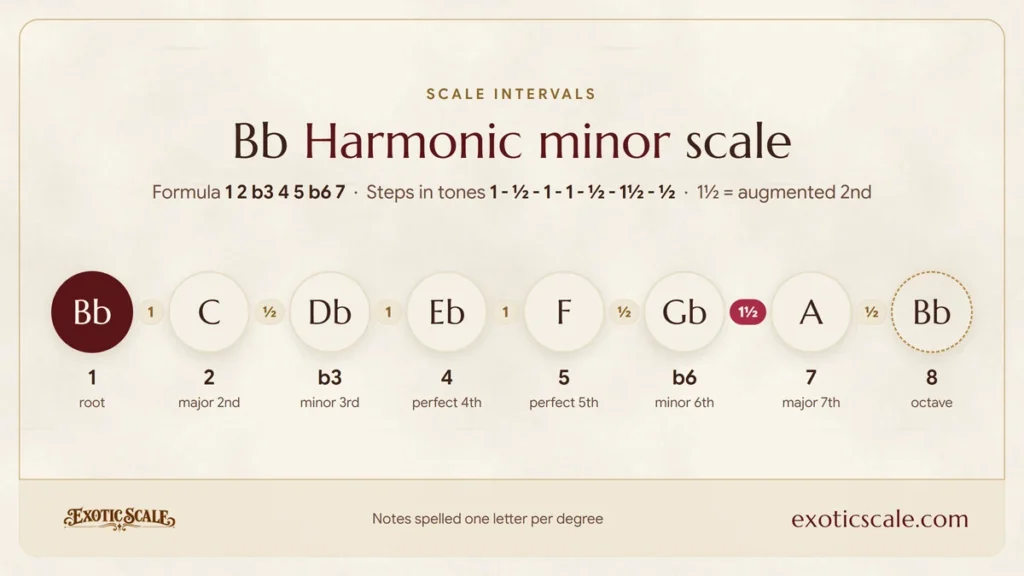
Bb harmonic minor is Bb C Db Eb F Gb A. It is written with 4 flats (Bb, Db, Eb, Gb). The augmented 2nd runs from Gb to A. In the harmonic minor scale, its raised 7th, A, sits a half step under the root, so the V chord F is major and leads home to Bbm.
B harmonic minor scale
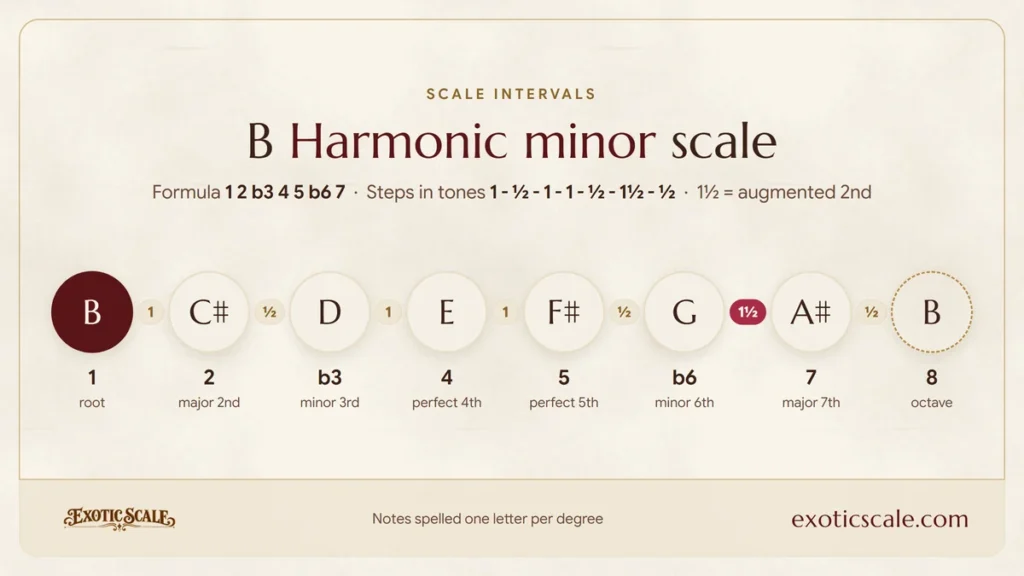
B harmonic minor is B C# D E F# G A#. It is written with 3 sharps (C#, F#, A#). The augmented 2nd runs from G to A#. In the harmonic minor scale, its raised 7th, A#, sits a half step under the root, so the V chord F# is major and leads home to Bm.
Harmonic Minor Scale: frequently asked questions
Short answers to the questions guitarists ask most about the harmonic minor scale.
What does harmonic minor mean?
A seven-note minor scale with the formula 1 2 b3 4 5 b6 7: the natural minor with a raised 7th. In A its notes are A B C D E F G#.
How is harmonic minor different from natural minor?
Only the 7th. Natural minor has a minor 7th, a whole step under the root (G in A minor); harmonic minor raises it to a major 7th, a half step under the root (G#).
Why is it called harmonic minor?
Because it is the minor scale the chords of a minor key are built from: its raised 7th turns the v chord into a major V (E in A minor) and gives the diminished vii° chord, the strongest pull back to the minor tonic.
What is the augmented second in harmonic minor?
The step of one and a half tones between the b6 and the 7, F to G# in A. It sounds as wide as a minor third and gives the scale its classical and Middle Eastern colour.
Which mode of harmonic minor is Phrygian dominant?
The 5th. Play A harmonic minor from E and you get E Phrygian dominant, the scale of flamenco and Hijaz melodies.
Is harmonic minor the same as raga Kiravani or maqam Nahawand?
Kiravani, the 21st melakarta of Carnatic music, has the same pitches. Maqam Nahawand often rises like harmonic minor and falls like natural minor, and its intonation is not equal-tempered, so it is close to the scale but not the same.